

Do you remember
The twenty-first night of September?
Love was changing the minds of pretenders
While chasing the clouds awayOn and on, say, do you remember?
On and on, dancing in September
On and on, never was a cloudy day
- September, Earth Wind and Fire
OK, as much as the dawn of the internet seems quite a while ago, it wasn’t actually as far back as the disco era. Even France’s Minitel didn’t quite stretch back to those days, though as far as internet precursors go it was a valiant attempt.
The one line explanation: the euphemism “Eternal September” was internet slang for the continuous influx of inexperienced users after Usenet access expanded to AOL in September 1993. That’s a little non-intuitive in a couple of ways… for instance, not all my readers will know Usenet and I fear more than a few won’t know AOL. So here’s the slightly longer version.
Before 1993, a lot of the social usage of the internet was dominated by university students and researchers (and the “permanent” - still transitory, but supporting longer lived threaded discussions in newsgroups - was largely Usenet, think of this as being a little bit like Reddit subforums and largely even more anarchic). Every September, a new batch of college freshmen got internet access for the first time. They were unfamiliar with "netiquette" (internet etiquette), broke unwritten rules, and flooded forums with repetitive questions. By October or November, the seasoned users had successfully educated, socialized/bullied, or ignored/banned the freshmen into conforming to existing community standards. This was the social policing structure that returned the Usenet culture to a baseline level of functionality. Much virtual screaming of “READ THE FAQ” (frequently asked questions reference list) was generally involved, because as a rule people were asking things that had been asked a zillion times before or doing things that many others had already come up with. These days, of course, a derpy LLM chatbot will happily dispense borderline-wrong answers for you to your frequently-asked questions instead of cranky Unix sysadmins telling you to read the FAQ - the end result may not be an improvement, however.
Anyway. The important change here is that the internet became available to everyday users as dialup internet became general-purpose… and the mover-and-shaker here was America Online (AOL). In September 1993, America Online opened Usenet access to its mainstream, millions-strong user base. Unlike university freshmen, this new wave of everyday users did not arrive in a single, manageable annual batch. They arrived in a massive, continuous, daily flood that never stopped.
Existing internet users realized that the Usenet community no longer had the time or capacity to socialize the newcomers before the next wave arrived. Usenet wasn’t built to scale for this level of interaction; AOL didn’t throttle people to consumption-only for Usenet (which might have mitigated this problem), and the sheer volume of new users permanently diluted the established netiquette. It was a culture shift - as well as a technological challenge - and a shift from the peer-to-peer node strategy of Usenet to an early HTML-and-web-centric strategy (or chat-room-based, as was common on AOL) threw the audience for a loop. This is not intended as a commentary on immigration, by the way, but draw your own parallels. Usenet does still exist today, as a bit of a parallel society to the internet, but it’s pretty esoteric these days - the amount of internet traffic that comprises Usenet groups is a rounding error.
But the phrase has grown to mean more than just AOL-invades-Usenet… because, as I implied… not only do people not remember Usenet, they increasingly don’t remember AOL. Which is kind of amazing.
At its peak around the year 2000, America Online was effectively the internet for the vast majority of consumers. It was a (fairly preposterous) cultural and financial titan that dominated global telecommunications and media.
In late 1999 and early 2000, AOL's market capitalization peaked at $222 billion to $226 billion, making it one of the most valuable corporations on Earth. In January 2000, AOL used its massive stock power to acquire traditional media giant Time Warner for $165 billion to $182 billion. The resulting mega-conglomerate, AOL Time Warner, was valued at $350 billion to $360 billion … the largest corporate merger in history.
Yeah, that’s gone now.
At its absolute peak, AOL had 30 to 34 million paying subscribers globally. By 1997, AOL controlled 50% of the entire U.S. market. And they did it by giving away CDs. Lots of CDs.
Now I’m going to have to explain what CDs were, aren’t I.
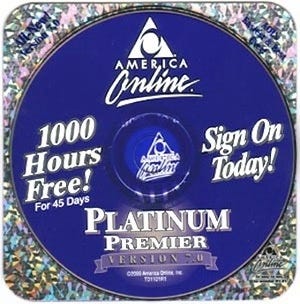
To get people online, AOL executed one of the most aggressive marketing campaigns in history. They manufactured so many free-trial discs that, at one point, more than half of all CDs produced on Earth carried an AOL logo. They were stuffed into mailboxes, magazines, and cereal boxes across the globe. I pranked one of my co-workers by filling his locker with them; when he opened it, an avalanche of free AOL CDs toppled out like the Closet of Fibber McGee. Don’t worry, he got me back.
AOL completely took over mindshare for digital communication with the awkwardly-named AOL Instant Messenger (AIM) and chat rooms, turning its iconic "You've got mail!" sound clip into a household catchphrase that even inspired a Hollywood film. (Not really the best Tom Hanks movie, though.)
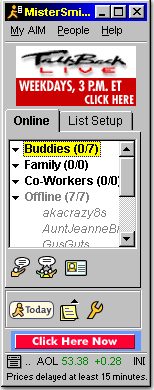
At its height, AOL gobbled up other massive tech companies, purchasing web browser pioneer Netscape for $4.2 billion (making Marc Andreesen a happy guy, at least) and navigation giant MapQuest (the print-it-and-go precursor to Google Maps and the mapping features everyone has built into their cell phones today).
They were determined to build-by-acquisition and buying Time Warner was clearly the peak of this. You may note that it basically all unwound thereafter and nobody wants to talk about that part of it.
Let’s talk about what it was like day-to-day… because the user experience was a lot different. I’ll skip some of the terribly eccentric bits - as much as some people thought Gopher was going to be a viable competitor to HTML, that’s not how it went down - and we sort of already touched on Usenet, which never really got to an end-user product due to the architecture involved.
Connectivity via dialup modem was loud and slow to connect - then very baud-limited. Most of the display protocols (HTML, Javascript, et al) were quite simplistic by modern standards so layouts tended to be simple, with relatively minimal imagery - it wasn’t entirely text-centric, but it certainly emphasized the text aspect of hypertext. And images took a while to load over 14.4 or 28.8 modems - 56k modems were the fastest you ever got over conventional phone lines. So videos required a lot of buffering, audio tended to be MIDI-clips, and until RealAudio gave us any vague semblance of streaming, the sound-enabled web pages sounded a bit like chiptunes (or video-embedded pages that would take … a while… to load.) Broadband was for office / campus environments, which were dominated by LANs and shared T-1 access, so a great deal of edge-caching infrastructure made things more responsive there (and Akamai revolutionized things by bringing that same concept to edge caches within ISP data centers, delivering warm caches of commonly used media to do what we all use Cloudflare and the like for today - but this technology was the only thing that kept the web from melting when everyone went online on 9-11 to click refresh endlessly for news… and ironically, the guy who invented the technology, my friend and Akamai’s CTO Danny Lewin, was killed on one of the flights that got crashed into the Twin Towers).
If you wanted to do precision page layouts and interactive media, you mostly wanted to use Flash, which was a proprietary environment for scripting actions and animations - that basically got used to build games and rich media environments that was embedded in web pages. But it wasn’t HTML, it wasn’t searchable, it wasn’t open - it eventually went the way of the dodo. Powerful at the time, though. Your alternative was to render everything in Photoshop and cut up the images, which made for slow-loading pages and was also not searchable, but at least didn’t have the compatibility issues that Flash sometimes presented.
Java was embedded in - and useful in - the browsers of the era. But it was not at all fast, and despite the promise of write-once-run-anywhere, its performance was very uneven across platforms. It made a useful extensible presentation layer to what the browser permitted, and let you do things you otherwise couldn’t. But the joke quickly became “write once, debug everywhere” - and it was true, I had a lab of systems to test my thin java client app that was mission-critical for my first startup so that we could be sure that we could maintain maximum user compatibility with a largely tech-unsophisticated audience. (But the appeal of “you don’t need to worry about installs, just load the damn web page and you always have the current rev of the client software” was hard to beat.)
Email dominated. Instant messaging was initially ICQ (“I Seek You”) and AOL Instant Messenger, with Yahoo Messenger and MSN Messenger coming to challenge them. This rapidly got out of control, with messenger popups everywhere. Email was largely a desktop product, though Hotmail and Yahoo mail changed that in a big way (Lycos Mail was around for a while too - other giants were Rocketmail, Excite, and of course the eponymous mail.com and its endless domain suffixes.)

Shared website hosting - personal websites - were definitely a thing. Geocities was one of the biggest nostalgia points, but there were many others following the same model. Tripod and Angelfire were big also, Fortunecity was the European equivalent - and Xoom claimed to offer unlimited webspace (you can guess how this ended). Nobody had the first idea how to make money at this other than crappy banner ads (and “referral rings” where you’d click through to affinity groups of mutual interest”). Sooner or later the dot-com bubble burst significantly because people ran out of money for underperforming banner ads. Most of these were absolutely monuments to the fact that people have no design talent at all.

Piracy via shared FTP sites (generally password-protected “warez” sites”) was common - trading music, files, ebooks, usually not movies because they were simply too big for the storage media of the time. Even music was difficult until the MP3 algorithm became common - and processors caught up to it.
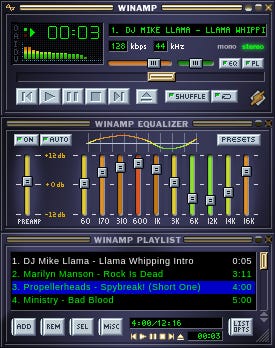
Somewhere around the end of this, Winamp became the MP3 player of choice - highly processor efficient - and Napster burst on the scene in its original peer-to-peer file sharing format. Also, fast follower Scour arrived - you likely don’t remember Scour, but Scour was famously sued for $250 billion dollars by the MPAA and RIAA - and it’s also famous because it’s the first company of Travis Kalanick, who you know as the founder of Uber.
Slow page-loads and a desktop-only browser environment made for some fairly different usage patterns, too. No need to develop for mobile phones
or be concerned about how your page would render on small form factor devices (tablets/touchscreens) - it was desktops and laptops, with a mix of dialup and broadband. (There was definitely a concern about Internet Explorer vs Netscape, or possibly Mosaic if you went back far enough - but mostly, Netscape set the de facto standard until the Microsoft juggernaut caught up and Ben Slivka’s team eventually surpassed them.) As a rule, internet companies had to assume for dialup users, and lucky customers had broadband of one sort or another … DSL or cable modem services were uncommon and often unstable, but still a great leap forward; you could theoretically get T-1 or even T-3 service from your regional telco (or a CLEC - Competitive Local Exchange Carrier - if you could pay for it; these were the days of telco deregulation) - but wireless broadband wasn’t really a thing yet. (T-Mobile was still VoiceStream Wireless, as part of Western Wireless, until Deutsche Telekom bought them. Verizon didn’t exist yet - it was GTE and Bell Atlantic and Airtouch, which came together in an ungainly merger that somehow passed antitrust hurdles - the deregulation in the telco space that broke up AT&T seems to have gotten reversed awfully darn quickly once the cellular business landed, huh? Different article, perhaps…) In any case, no wireless broadband to speak of yet, just pagers and early cell phone service. So that led to some… idiosyncratic and theoretically innovative behavior.
Flash, as mentioned, was one of these sort of workarounds. People couldn’t really stream videos, but shipping animations in the form of sprites and vector graphics that could render and scale up in your browser - adjusting to your screen size and looking good on whatever display you had? That was doable. And rather than using your entire bandwidth pipe to send uncompressed audio, or even a compressed stream, something rendered / synthesized on your computer used not-all-that-much computational power… ultimately, this was the sort of technology built for video games… so if it was rendered background music and a lower-fidelity (phone quality) stream of conversational speech, this was a useful compromise. Even if that sounds like it might be a bit like elevator music / hold music, it beat the audio quality of trying to pipe it all through your phone - and it tended to come with distracting sprite animations that made it more entertaining when a virtual Chuck Norris-lookalike was delivering the message.
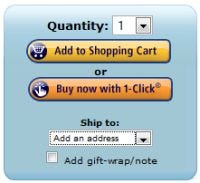
A similar low-bandwidth innovation came from Amazon, and it didn’t look as glamorous - in fact, people complained about it (and I did too before I was part of Amazon and understood how it worked for the customer, I still think it’s crazy that it’s permitted as a patent.) This was the famous/infamous “One Click Purchasing” patent - the “Buy It Now” button on Amazon, where if you were signed in to your account, any given product detail page suddenly became an impulse purchase - you could add things to the shopping cart as usual and go through the usual checkout process, or you could click “Buy It Now” and Amazon would charge your default payment card, ship it to your default address, at standard shipping terms - something that became even more convenient once Amazon Prime lowered shipping to “de facto free, I’ve already paid for it by paying for the annual subscription service”). But here’s the genius of it, in the era: the observed customer behavior for Amazon’s “power users” was decidedly different than that of other major ecommerce sites. People would get on eBay and browse around for hours, bidding on a variety of things, noodling about, doing some comparisons, being outbid and coming back, maybe trying to sell something of their own, and generally behaving like a bazaar or a swap meet. Not a lot of the same with Amazon… the usual model there was what was termed “spear-fishing”: people would come to the site knowing what they wanted, before the page had even loaded they would click into the search box and type in whatever it was (for instance, some variant on the term “Harry Potter and the Chamber of Secrets”) and Amazon’s search engine - being pretty good at mapping customer requests to the actual desired item, would take them directly to the product. The customer would see this, click through and confirm that this was the new Harry Potter book they were looking for and at a good price, hit the one click button - again, before the page finished loading - and Amazon would refresh to an order confirmation screen saying “thanks', we’ll ship you the book!” And the happy customer had completed a purchase and was gone - in less time than it would have taken to load the front page in the first place - because the one-click process reduced commerce friction so much, and they trusted Amazon to get it right (or make it right, if fulfillment got screwed up) - and this turned out to be absolutely critical for growing the happy repeat-customer base.
Jeff Bezos insisted on the key metrics of “Customers Delighted” versus “Visitors Pissed Off” (when the site malfunctioned, was inaccessible, orders went awry, or the like). And Amazon optimized very heavily in the early days for being customer-centric - trying to delight as many customers as possible and build/retain a strong, loyal customer base, with the theory that their brand meant something: so fast convenient shopping was key, fast service was key, excellent pricing was key, stocking everything they wanted was key (even if it wasn’t in the warehouse, if it was available in the order pipeline amongst various distributors then Amazon would let you order it and handle the fulfillment supply chain to delivery, this was far better than you could get from your local bookstore, who would give you a blank look if it wasn’t on the shelf), responsive website was important, bending over backwards to make sure the customer was happy via returns was seen as less a cost center and more a means of investing in the relationship (and learning what the customer wanted) - it was a haphazard engine of economic innovation, but there were a lot of smart people working towards the goal of delighting the customer, and a lot of dot-com investor subsidy going towards growth.
Jeff was fond of telling a parable about this being the Cambrian era - huge diverse ecosystem in the form of different dot-com companies, and it was clear not all would make it; the parallel that we were all about to be hit by an economic asteroid was also inevitable, I suppose. And the dot-com crash did pretty well demarcate a definitive end to that first grandiose era of the internet.

The year is 2000 and a girl tells you she has DSL. Whatever she’s referring to, you’re in for a peak milllenial experience.
For Years There's Been Nothing But The Static On The Radio.
If you can hear my voice outside these walls; if you can hear me sending out this message tonight.
Break The Silence, Send A Signal Back (if you can hear me)
I'm coming home all I need is a little Guiding Light...
If You Can Hear Me/
Don't Turn Your Back On The City.