

Let’s dance in style, let’s dance for a while
Heaven can wait, we’re only watching the skies
Hoping for the best but expecting the worst
Are you gonna drop the bomb or not?Let us die young or let us live forever
We don’t have the power but we never say never
Sitting in a sandpit, life is a short trip
The music’s for the sad menCan you imagine when this race is won
Turn our golden faces into the sun
Praising our leaders, we’re getting in tune
The music’s played by the, the mad manForever young
I want to be forever young
Do you really want to live forever?
Forever, and ever
Forever young
I want to be forever young
Do you really want to live forever?
Forever young- Forever Young, Alphaville… classic GenX anthem

Though I often agree with Kryptogal (Kate, if you like) on a number of topics, and I suspect she’ll recognize this song from … if nothing else, high school dances Back In The Day…
This is a topic for which we have some dissonance. There’s a few notable ones of those, too - like “should you have kids?” - and perhaps the difference in perspectives here is linked, but we’ll come back to that.
Her essay, which I encourage you all to read, opens with an AI summary quote that excerpts the phrase:
“old people are the happiest people on earth, and young people more unhappy than they’ve ever been”

So if you’re thinking of the cranky old son-of-a-bitch across the street and thinking “wow, everyone else must be really outrageously happy to make up for Grumpy McGrumpypants” your instincts are correct and the AI quote is wrong. To be entirely clear, Kryptogal calls this out as a lie AI told her. You might think “oh this is survivorship bias, the people who were absolutely miserable and dying of something horrid and painful have perished" or have… let’s politely say euthanized themselves, now that programs like MAID have become socially acceptable.
But the lovely Kryptogal quickly gets to the actual point of her thesis:
Being in your 20s is not so great; being in your 30s and 40s is way better; people in their 60s and 70s are the happiest people on the planet; women have an easier time of aging than men; and - oh yes - this is basically true only in the West (the US, Canada, Australia, New Zealand, and Western Europe).
This isn’t actually a statement that getting old is great. This is a statement that these are wealthy nations with a strong social infrastructure, and that being wealthy is great, especially if you survive to enjoy it… and for the effect of compounding wealth to make your nest egg sizable. (See the earlier “survivorship bias” caveat? Unhappy folks who die earlier - crime, suicide, lack of adequate health care - they’re not around to complain; the rest have it pretty good. This is a tontine.) And that the boomers are wealthy.
(Mind you, this isn’t entirely true: as usual, about 20% of the population has most of the wealth, the next 30% has the other third of the wealth, and the other half of the Boomers are scraping-by-on-Social-Security-and-Medicare-and-meager-pensions, and visiting their local food banks.)
But look at why life is great for older folks who have made it (and why there’s such resentment for boomers) - they’re seen as living it up at the expense of the younger generations who are supporting them, taking flashy vacations, buying enormous boats, and engaging in conspicuous consumption of the sorts that you’d otherwise expect from social media influencers or Kardashians or rap music videos (if you are of the age to remember MTV). There’s some heartburn from the younger audience that the parents are spending their inheritance (contrary to how their own ancestors had frugally handed down a sizable nest egg to the Baby Boom generation) and that this is a violation of the social contract that the boomers had preached; correspondingly, the elders generally seem to think they’ve built this, they deserve it, and that their millennial offspring are likely to ineffectively fritter it away if and when they inherit it. Without relitigating an overly discussed generational malaise, I will say: there’s truth to both sides of that story (have some compassion when you talk to your family members around the Thanksgiving table) - also that you should probably expect to have to solve your own problems regardless of how nice it would be if other people solved them or helped to do so - and also also, that it would be highly distracting to spend much time on this topic and I should get back to talking about Kryptogal’s thesis.

But on the face of it, you might find it pretty plausible that - especially with modern medicine reducing both mortality and the day to day aches-and-pains (and general infirmness) - that being somewhat older is probably pretty great, right? Let’s say you’re in your 60s and you’re an empty-nester (your kids are out of the house and only maybe come visit home occasionally for holidays), you’re about to retire or maybe you’ve taken early retirement - or you’re on pension from your first job and are about to retire from your second career, you’ll have a ton of spare time and you’ve got a lot of space in the house without a lot of demands on your time from kids and upkeep. Your income is probably pretty good, your house is probably paid off or nearly so - and if not, your mortgage is probably pretty low. You take a fair number of pills, but they control a lot of symptoms that would have really inconvenienced your parents or grandparents - perhaps to your wife’s annoyance, one of them keeps your sex life alive, perhaps more alive than she would particularly like to otherwise put up with but not enough for her to put arsenic in your wine. Your 401k is reasonably good because the stock market has been good most of your life (apart from that dot-com crash), your house is worth quite a bit because the real estate market has been good most of your life (apart for a little bit there around 2008), Social Security is going to cover a bunch of the expenses that you are going to still have once your paycheck goes away, and you’ve managed to save a reasonable amount anyway. Cable news tells you all sort of terrible things about what’s going on in the world, whichever flavor of editorialized news you prefer, but it’s always The Other Party’s Fault and the people you’ve listened to and trusted for years are there to tell you comfortable messages.
Now perhaps this is, as she intimates, the gender divide: women are more content to age gracefully; men are are more concerned with staying young. This sounds questionable: if memory serves, and it always does, Kryptogal was not averse to certain cosmetic procedures herself to retain the appearance of youth. No shame there, this is the nature of the world.
So then, why not also focus on the deeper issues of aging, and not just the cosmetic ones? What may seem like a pleasant mellowing, perhaps a dampening of certain distracting urges, is of course the slowing and failing of certain endocrine systems - a path that women generally lament for osteoporosis/osteoarthritis and similar conditions… and less commonly recognized, female heart disease spikes post-menopause as the protective effects of estrogen diminish or disappear. Women are disproportionately affected by Alzheimers, tending to experience faster cognitive decline than men. And as many people have probably noted, women are more subject to depression than men throughout the various phases of life - but again, this particularly spikes with perimenopause and menopause (and often compounds with exhaustion at that point). Many of these effects can be treated by anti-aging therapy (readily available HRT and suitable exercise - generally resistance training) - and this is by no means to say that this recommendation is limited to women; schlubby men who look like Homer Simpson or Tim Walz (or let’s be fair, Donald Trump’s not as svelte as he likes to tweet about either) tend to age poorly too… but as a rule, men are much less averse to the idea of going and lifting weights.
You will not stay young indefinitely. But you can stay vital much longer, and the funny thing is: mostly, people know the basics of how to do this (and don’t do it anyway). Stay socially and mentally engaged (without being enraged), stay physically active, eat a diet that is low in sugar and other refined carbs.
There are a lot of things that stack up beyond this. I got dragged into various health maximizing protocols at a young age - some of this was some granola influence from my mother’s friends (we had a phase where we had a lot of food from health food stores; as a child I grew very tired of carob chips as ersatz chocolate - eventually the whole family decided this was largely for the birds), some of it was a friend who got into the Life Extension movement and introduced me to the Durk Pearson and Sandy Shaw books and protocols. Those (and Linus Pauling’s work on Vitamin C) were sort of pop culture mainstream for megavitamin science - what would develop into orthomolecular medicine - but was absolutely seen as The Next Big Thing by millions of people back in the 80s, at least judging by how many copies of these books were sold and how popular these guys were for a while.
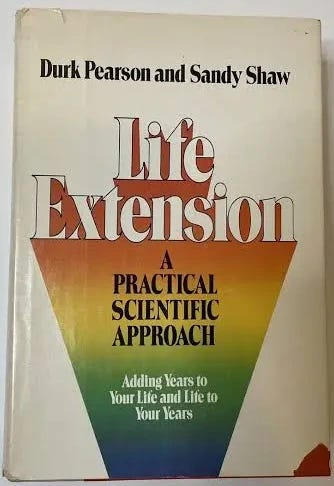
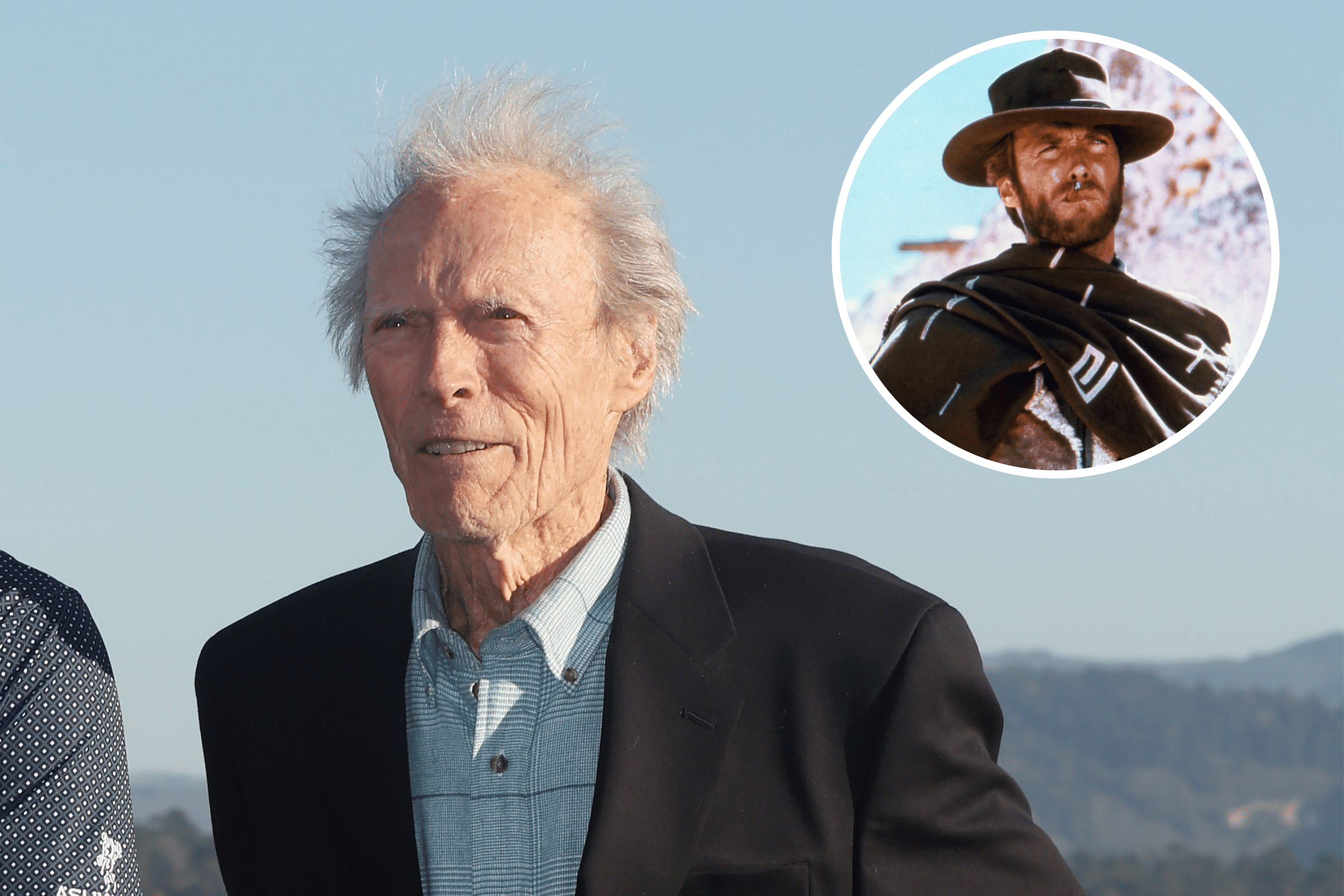
Even (or especially) for a pop-science book, in 1982, this was a monster book, coming in at 858 pages! It was conversationally written, illustrated with cartoons in a style that mimicked magazines rather than more usual texts, and generally was targeted at bringing nutritional science to an extremely mainstream and largely midbrow audience (to their credit, Pearson and Shaw did spend a significant section of the book actually footnoting and documenting their research so that you could go dig in further; the appendices here were voluminous). A few sequel books also followed (including inevitably a Life Extension Weight Loss Plan); Durk Pearson and Sandy Shaw became micro-celebrities with regular television appearances and had a bit of a cult around Hollywood - including one of their biggest fans Clint Eastwood, who enlisted them as screenwriters for Dirty Harry film The Dead Pool. Truth is stranger than fiction sometimes. They got a guest appearance therein, Alfred Hitchcock-style. You might reasonably consider this to be a pretty good endorsement though - Eastwood has aged remarkably well; as I write this he’s 96 and his last movie was released only two years ago, when he was 94.
Some are like water, some are like the heat
Some are a melody and some are the beat
Sooner or later, they all will be gone
Why don’t they stay young?It’s so hard to get old without a cause
I don’t want to perish like a fading horse
Youth’s like diamonds in the sun
And diamonds are foreverSo many adventures couldn’t happen today
So many songs we forgot to play
So many dreams swinging out of the blue
We’ll let ‘em come true
And then there were some odder influences. When my youngest had a vanishingly rare endocrine condition - childhood-onset hyperparathyroidism - the Children’s Hospital doctors informed me there were less than a hundred cases on record, and sent me to some unusual sources, not just the conventional collection of esoteric experts at Johns Hopkins (my usual go-to for top-of-the-mark medical knowledge). One of those was a frontier researcher of sorts - a invitation only sports medicine forum run by a fellow pseudonymously named DatBTrue.
I hadn’t quite realized what I was getting into here at first when I joined, but it soon became apparent what an absolute vault of knowledge was here. DatBTrue ran an exclusive membership group for some extraordinarily talented people, and I got waved in only because I’d been vouched for by one of his preferred doctors.
Once I was inside, though - this wasn’t primarily esoteric endocrinology and very little of it was for kids: this was for the absolute powerhouse athletes, trying to push the boundaries of the system. There were professional NBA, NFL, and MLB players, and Olympians or Olympian-aspirants - all looking to… find an edge, or at very least understand where the edge was. In the days when peptide protocols were still early and mysterious, this is where some of this was first systematized and codified, with actual research and science - and similarly for many of the other compounds that people could use to various enhancement purposes: the means used to win the Tour de France were discussed, by those competing for it… all carefully pseudonymized, of course, but there was little doubt that many of these people were the actual competitors and/or their sports medicine team. Most avidly, the athletes who had pushed the limits to the redline (or beyond) were in this forum pursuing their recovery protocols - to recover their bodily functions, restart their endocrine systems after absurd steroid or other performance-enhancing drug cycles, and hopefully retain or regain their ability to have children; likewise preserve what was left of their knees and other joints so they could continue to walk into their forties, fifties, and beyond: that high-intensity pro-athlete lifestyle is brutal on your body.
It was fascinating, it was a whole different world, and there was some overlap with the life-extension world as well - some definite thought to how to set back the clock. It all vanished in a big hurry when a scandal exposed the whole world of sports doping - thankfully, I’d gotten my daughter into the correct treatments for her edge-case endocrine disorder before then - but even to this day, DatBTrue is remembered in certain corners of the internet.
Well, in the near term, Bingo has been cracking the metaphorical whip within Tortuga with his summer Fitness Challenge - which, to his credit, has prompted me and several others to get off our respective keisters - though I’m still nowhere near even in the neighborhood of the DatBTrue super-athlete crowd.
And now that the first round of the Tortuga challenge is wrapping up - a second cardio portion will fill out the rest of the year, and then a more complete physical challenge will follow next year - we’ll have a variety of articles following up over the next year or so constituting the Hyperborean Protocols, the guidelines implied and inspired by this very article: the call-to-action to build yourself into the better, more vital, more long-lived, clear-headed, more physically capable version of yourself. Not just a vague call to go to the gym more often and “just do it bruh” but pragmatic, concrete, and slightly cynical meme-filled guidelines - you know, the sort of thing you might expect from my writing in general - an actual road map on how to win.
Our physique chapters will cover “Building the Better Beast” - from exercise to supplementation (both the GNC end of things and the DatBTrue-worthy discussions) to stretching to recovery, guidelines for men and women, younger and older, because one size does not fit all. And that’s only the first section - we’ll also venture into “Overclocking Your Brain” - the science of keeping your mind sharp under stress, age, and fatigue, including exploration of the state of the art in nootropics and retrospectives back to the dawn of the space with Durk and Sandy, Mondo 2000, and the Smart Drugs investigations, books, and journals. Then we’ll close it out with “Your Next Century” - the comprehensive look at the state of the life extension space and protocols, what you can do to live longer, happier, more vital lives: not just cope and woo, nor just “take this pill and everything will be fine trust me bruh” but a look at the experts, the frontiers, the science, and the pragmatic recommendations from the people who know what they’re doing.
Norse legend credits Idunn with bearing the Golden Apples of Immortality - which restore youth and vigor. Even our fair Kryptogal might not mind occasionally partaking - in the apples, you gooners - if only to preserve her best self against a brighter tomorrow. Thus far, this is myth - aspirational myth, but not something anyone can practically offer you.

Whether the visions of boutique life-extension clinics come to pass remains to be seen: to a certain extent, it’s plausible, and before you despair about how this means late-stage capitalism vitrifies into brutal class distinction on yet another level, let me offer the counterpoint.
When new bleeding edge technology developments arrive, the frontier-grade stuff tends to be horrifically pricy, and then as it becomes more mass-market the prices absolutely plummet. The Apollo Program was about half a percent of the US GDP per year while it was running - meaning, half of one percent of all the nation’s economy: more to the point, that meant it was about 4.5% of the government’s spending in the late 1960s (for comparison: also roughly what we were spending on building out infrastructure during the nationwide rollout of the superhighway system). By comparison, SpaceX - though still quite expensive - replicated the same thing on a relative shoestring, and the next competitor will do it for less. More to the point, in health sciences: first sequencing of the human genome cost $2.7 billion dollars and took 13 years to perfect: you can now pay roughly $600 and it takes about four hours. When the only option for international communication required a new Telstar satellite, it was horribly expensive - when it instead involves a cheap burner phone that you can pick up at 7-Eleven, you can probably get started for somewhere around $40. Isaac Newton’s timeless aphorism about “standing on the shoulders of giants” is all too applicable here: modern scientific progress builds on - and becomes affordable on - the developments of others.

So - do not accept some gradual decline into senescence; do not make a virtue of aging gracefully into decrepitude; do not perish like a fading horse: instead, rage against the dying of the light. Tomorrow is better, if you make it better - stick around, stay vital, stay engaged, and make the best of your life and the world around you; leave a legacy not just of boats and vacations but of your own health and the physical and mental health of your progeny as well.
I’m gonna get the girls redone next year. I made a promise to myself.
Did I forget to mention in my essay that one should absolutely not let oneself become old AND poor??
If I did, that was an omission, bc it's a very important point.
Yeah, I admitted, the body falling apart part is the worst part, and in no way good. This really comes home to me as I picked up my first pair of "transition" glasses yesterday, or what used to be called bifocals, which I was very excited about to finally be able to see again. And then discovered that the second I put them on they made me intensely nauseated and there's no way I could actually drive (or even walk) in them and that it will probably take a month long training protocol just for me to even get used to wearing them, if I ever do. But still, having more time and money make up for that stuff, I think, at least nowadays with the medical miracles. If one could have all three that would be nice, but I just assume almost nobody can have all three.
Good piece and yes, I concede, if it's the case that I left out the part about how you need to not be poor when you're old, that was a mistake bc I intended to make that clear. Being old is mostly enjoyable to the extent you have more autonomy, free time, and less obligations or duties, I believe. Like being a kindergartener, but with money. So people should make sufficient efforts to make sure they don't have no money at that point. I'm not sure how much one can control the health aspect.