

Lapping up the smoke from a factory chimney
Marching to the beat of a heart within me
Hey ho, hey ho, we're off to work again
Bells are ringing, we are singing, joyous in our industryI love my job, he loves his job
Pull that lever, start the engine
Pump the water, build the pressure, push the piston, press the button
Pump the water, build the pressure, push the piston, press the button
It's the perfect jobHappy Workers, Tori Amos
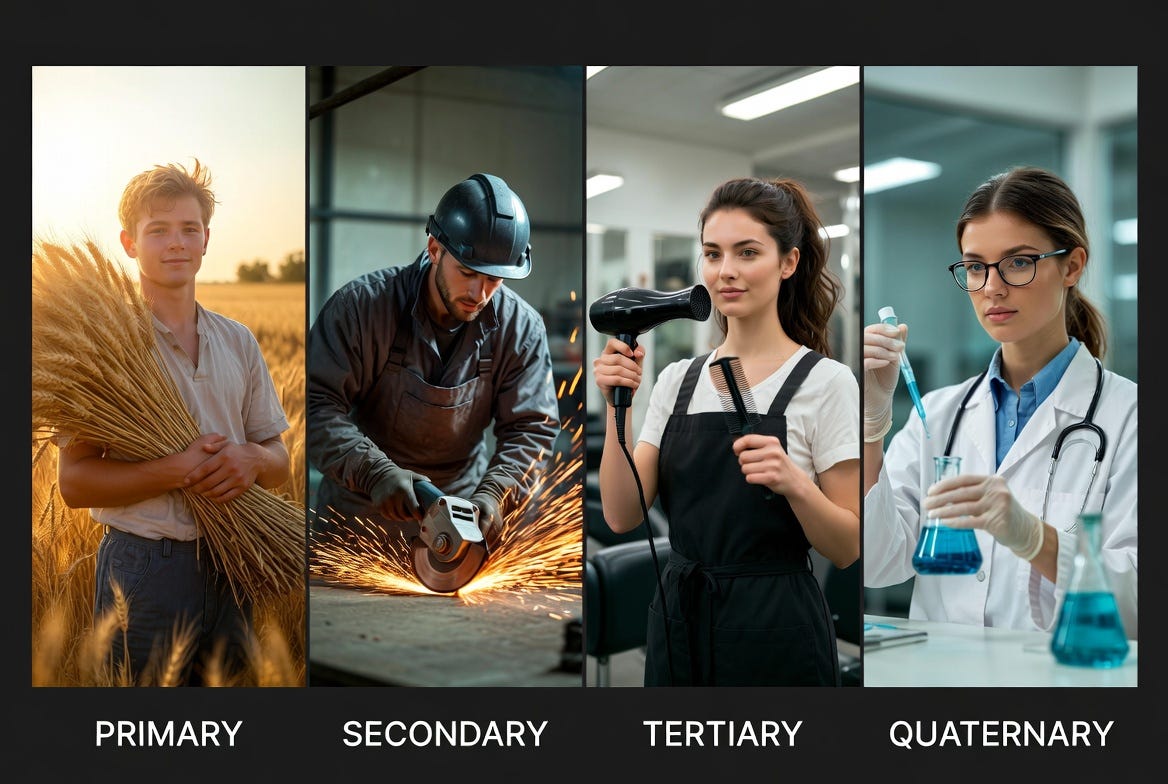
Sometimes classifications get taken a bit for granted within a field of study - a point brought to mind recently when what I thought was fairly straightforward group conversation amongst members of the Tortuga Society had a puzzled moment from one of the participants who said, quite reasonably: “what do you mean by the tertiary economy?” Not having had the benefit and/or exasperation of being trained in economics, the terminology didn’t map to anything in particular - whereas when it was explained as “the service economy” this was something legible, and the concrete examples of “things like banking, retail, healthcare, and the like” put it in straightforward context.
So economists typically divided the world as they see it - meaning the economic world - into four main sectors, based on the type of activity involved. These are often taught as the primary, secondary, tertiary, and quaternary sectors, and here’s the once-over on each of those. (I say these primary four - there’s generally also a fifth quinary “governing sector” suggested as the high level decision makers, effectively the ruling class / steering class whether they be government, corporate executives, senior religious officials, think tanks, or the like - but it’s tiny. I will use that terminology in this document - but keep in mind, some people will disagree.) Economists also like to talk about the “shadow economy” - and I’ll come back to that later - but that isn’t the same as this; fundamentally, the shadow economy is the area untracked (or undertracked) by official sources - it’s the black market and the grey market of “under the table” transactions (whether outright criminal activity or just cash-in-hand undeclared income like babysitting or dog-walking) - also, altruistic volunteer or pro bono efforts - and of course old fashioned barter.
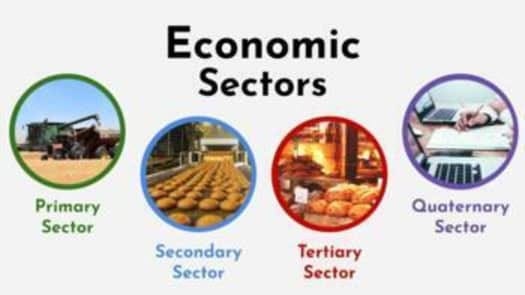
The primary sector is the extraction economy - it derives value from extraction of raw materials. Generally this involves directly extracting or harvesting natural resources from the earth, so it will be things like agriculture, farming, fishing, forestry, mining, oil & gas extraction, quarrying, and the like. It might also be called the “extractive sector” although there’s often some cynical / tongue-in-cheek references to taxation being extractive - but economists generally mean literal extraction rather than coercive extraction. As you might expect, this is sort of early-stage economy in most cases; it’s most important in developing countries with large rural populations. A common example: a farmer growing wheat or a miner extracting copper. Of course, a number of petrostates run on the extraction economy and sort of never grow out of it - as you might suspect, this becomes very unstable when you start to run low on whatever you’re mining or drilling or quarrying - but it’s difficult to transition such an economy for various reasons and we’ll come back to that.
The secondary sector is generally manufacturing and construction - approximately, using the outputs of the primary sector to produce other things people want. If this sounds a little bit like the sort of definition that Karl Marx might apply for Labor Theory of Value, you’ve got the right idea - it involves transforming the raw materials from the primary sector into finished or semi-finished goods. The sorts of things that typify this class of the economy are going to be - of course - manufacturing, factories, processing plants, construction, utilities (electricity, water), and refining. Depending on the era (or who is doing the reporting) you will often hear this called either the “industrial sector” or “manufacturing sector.” The classic examples are things like turning iron ore into steel, assembling cars or planes in a factory, or building houses.
Now for that mysterious tertiary sector, the service industry. Roughly, this involves providing services to consumers and businesses rather than producing physical goods. A lot of our economy today falls in this camp: retail (and wholesale), transportation, healthcare, education, banking & finance, hospitality (hotels, restaurants), tourism, entertainment, government services, IT support. There’s some disagreement as to whether government services actually belong in this sector or ought to be a splinter sector of their own (or are even just a drag on the economy entirely); also, arguably, some the elements in this sector bleed into the quaternary sector as that develops - that line is inevitably blurry, as you’ll see in a minute. The tertiary sector, especially when taken in conjunction with the quaternary sector (being sometimes hard to neatly separate) represent the largest sector in most developed economies (often 70-80% of GDP in countries like the US, UK, etc.). Examples include a doctor treating patients, a teacher in a school, or a software developer providing cloud services. But it also includes a sailor or a truck driver, a janitor or a maid in a hotel, and other folks much lower on the economic totem pole - roughly speaking, if what you do for a living is sell your labor or skills rather than directly make things, you’re probably in this camp (or the next one).
Which is why the distinction for the quaternary sector - the knowledge and information economy - is a little less distinct that you might think. This is your proverbial email or keyboard job these days, but perhaps more formally, it focuses on knowledge-based activities, information processing, and intellectual services. The key activities: research & development (R&D), higher education, scientific research, data analysis, information technology, consulting, media & information services, biotechnology. Traditionally it was sometimes merged with the tertiary sector, but increasingly separated as economies become more knowledge-driven. Some examples: A university researcher, a data scientist, or a company developing new AI technology. One might reasonably say “this is the tech economy” and you wouldn’t be far wrong - but you could reasonably quibble: does fintech fall into this camp or is it old school banking with a veneer of high tech? Does e-commerce live here, or is that just retail-and-fulfillment with “on-the-internet” slapped on for high tech buzz and scale? Is Tesla (or for that matter BYD) actually a manufacturing firm in the secondary sector (yes, it is) or a transformational robotics and software firm that happens to make cars and lives in the quaternary sector (eh, much more the former, with some employees in the latter, as it stands today)…
And for the sake of being complete, the “optional” fifth sector - the quinary sector is effectively high level decision making. There is, as mentioned, some debate as to whether this actually belongs in the overall classification taxonomy, but I’d be remiss not to mention it as you’ll probably hear reference to it if you hear people use this classification system. Generally, it involves top-level government, corporate executives, policymakers, and senior officials who make high-stakes decisions. Key activities would be senior government roles, top corporate leadership, think tanks, international organizations. Example: CEOs of large corporations, heads of state, or central bank governors (or comparable positions at similarly influential multinationals - like the World Bank or even the Red Cross).
There’s always a lot of crankiness when it comes to trying to divide the economy any particular way. Is it actually reasonable to say that service workers are a sufficiently similar bucket that they should all be considered one broad group? There’s certainly reasonable basis to try and distinguish skilled or unskilled labor - traditionally, artisans and engineers, or perhaps a professional and rather high-income class of doctors/dentists, lawyers, bankers, and the like, plus more recently the tech hoi polloi as well - and say “you probably aren’t going to get far by trying to unionize them alongside the baristas, dishwashers, cashiers, or janitors”. Certainly it tends to not go well for the sorts of people who want to do such divisions on a Marxist kind of basis, at least, and thus the classic division there would be between wage labor “working class” (blue collar) and “professional class” (white collar), though you’ll also occasionally see distinctions like “pink collar” work for roles that traditionally went to women (secretary, nurse, certain types of teaching especially for kindergarden/pre-K, dental hygenist, ballerina, hairdresser, and childcare) - though you’ll probably not be surprised to learn that this last distinction hasn’t really held up in recent decades.
But one might reasonably ask with this division of the economy: well, that seems all a nice abstraction and kind of detached from reality. (This sort of complaint gets leveled at economists a lot, the same way that physics jokes start with “assume a spherical cow.”) But is the government really part of the service economy? Because in a lot of parts of the world and a lot of parts of history, that isn’t a very accurate description; it might be the zeroth' economy (to steal a term from Asimov’s Laws of Robotics). Heaven knows in many places the government is - or has been - also the primary owner of the resource extraction rights - and thus happens to be the majority of the nation’s economy… and even when they’re tacitly not, from time to time there’s a nationalization grab and then it turns out that they in fact are again de facto the nation’s economy. Except inasmuch as the rest of the world’s economic system objects and crashes the nation’s bond market, such as seems to happen to Argentina roughly every time the wind shifts and bad decisionmaking ensues.
Even if we sort of agree that government can neatly fit into one or several of these buckets, however, what about the other elephants in the room as far as the world’s economy goes… like, for instance, how about the rather large economic impact of crime? It’s a little difficult to model, perhaps, but it’d be foolish to say it isn’t there - and in some cases it’s a substantial - even the dominant portion of a nation’s economy in at least a few cases. (If only for the simple reason that the nations in question can’t much keep control - your proverbial failed state or narcostate or just outright anarchy!) The handwave you’ll probably hear from economists is that there’s a parallel economy for most of these categories - for instance, a primary extraction economy to grow illicit crops, a secondary extraction economy to produce bootleg goods, and again mostly a tertiary economy involved in actually performing various nefarious actions of carrying out criminal enterprise (whether that be organized crime or individuals acting impetuously). One presumes there must be even a quaternary economy of, err, cutting-edge crime (the puns that could ensue from this are endless) and the various famous crime lords (Capone, the Gambinos, Pablo Escobar, El Chapo, El Mencho, et al) implies a high turnover quinary economy as well. This tends to follow a sort of overly simplified Gary Becker rational economic model of crime - regarding everything as economic costs, transfers, and rational decisions, ignoring social costs, lost productivity, and enforcement / policing costs.
If you’d rather not turn your mind to the darker side, let’s consider the hopefully brighter side of humanity - and one of the other bits usually considered “outside the economy” - or at least outside the realm of what kings and nations are permitted to freely tax, by which I mean: religion (and its adjacent secular space - nonprofits). Where does religion fall into the economic structure of society?
Religious activities are overwhelmingly treated as services - the tertiary economy - because they involve providing intangible benefits to people (broadly: spiritual guidance, community support, rituals, counseling, education, and social services) rather than extracting resources or manufacturing goods. There is, inevitably, some level of manufacturing and construction: someone has to build the churches, someone makes the books and candles and so forth, but the days when the Church had any real presence in vineyards and farms the commensurate primary economy is largely past. Arguably there’s some quaternary knowledge activities along the lines of theological research and religious publishing, and quinary activities from senior clergy setting doctrine and strategy (especially when you get to leadership of the respective faiths - the Pope still swings reasonable influence and recent news would tend to indicate the Ayatollah seems to be a player in world events) but these are virtually a rounding error.
Much akin to religious activities, the secular equivalent of non-profits, charities, and NGOs represents a set of institutions that operate independently of government and business, focusing on social, humanitarian, environmental, advocacy, development, or charitable goals. They are not a separate “sector” but are classified by their activities.
Mostly their work involves work involves delivering services to people or communities, so again they live in the tertiary economy. Examples would be running humanitarian aid programs, disaster relief, healthcare clinics, education projects, poverty alleviation, environmental conservation fieldwork, and community development. Perhaps more than religious groups, they tend to aspire to a quaternary economy participation - to engage in research, data analysis, policy analysis, awareness campaigns, training, and knowledge dissemination. A lot of this is a mandate for advocacy: think tanks producing reports, environmental NGOs conducting scientific monitoring, human rights groups documenting abuses and publishing findings, or development NGOs evaluating program impacts. That in turn would probably lead you to the conclusion of quinary involvement: leadership and strategic roles in large or international NGOs involve setting policy directions, allocating resources, influencing global agendas, and high-level advocacy. You might cite examples of executives at organizations like Amnesty International, Greenpeace, Oxfam, Doctors Without Borders, or the heads of major foundations deciding on global strategies. Some sources explicitly place NGOs and their leadership in the quinary sector alongside top government officials and corporate executives; certainly Gates has done his best to transition into this role with his foundation as he moved out of comparable role at Microsoft - and he was quite successful at it, though recent scandals may have tarnished this.
But due to their presence driving volunteer efforts - and their dealings with the unbanked, the homeless, and the marginalized - both religion and non-profit charity work are very significant factors in the shadow economy. This phrasing makes them sound nefarious and generally they aren’t - other than the inevitable “the road to hell is paved with good intentions” sort of conclusion where people trying to do the right thing often end up causing endless trouble. You may, of course, be entirely excused if you look at any given religion or charity or NGO and say “the goals of this group are entirely opposed to mine and they are in fact making the world worse” - I’m sure we could all make a little list, if you wanted to channel The Mikado from Gilbert and Sullivan. But for every person who thinks - perhaps justifiably - that George Soros’s Open Societies Foundation is the death knell of Western Civilization, there’s someone else who thinks it’s saving the world, so let’s delve into that another day.
Let’s talk a bit more about “the shadow economy.” It’s a somewhat pompous name for “things we don’t reasonably know how to tax and control” and also sort of falls outside the realm of easy government stimulus, apart from direct “helicopter drop” cash injection. (You might think that’s less a concern than the regulation and control perspective - and you’d be correct that it’s less, but you might be surprised how much thought is still given to wanting to be able to do it when necessary - it’s not, as it were, far less a concern - influencing the economy is not just a matter of taxation but also of employment and thus political stability.)
Generally this would get broken down into a number of categories. The bulk of this is going to be legal but unreported or just informal activities (which is probably most of the shadow economy in many countries). Think of this as things like cash-in-hand work (e.g., babysitting, tutoring, freelance gigs without invoices, the proverbial teen-mowing-your-lawn, and the like). Likewise, some of the extremely local services - street vending, small-scale farming, or home-based services not registered. Self-employment in the informal sector (common in developing countries, or for people who are for various reasons hard to employ.) Then there’s the “black market” subset - iIllegal / criminal activities - the sort of thing you’ll see on police procedural television or highly fictionalized shows about the same (eg Breaking Bad) - drug production and trafficking, human trafficking, smuggling, counterfeiting, illegal gambling, extortion, or unlicensed weapons trade, various forms of fraud or money laundering. You know enough to steer clear of this. And then there’s various grey areas: Activities that are technically legal but hidden to avoid compliance costs (e.g., unlicensed small businesses operating in regulatory grey zones).
I should make an important distinction: Household production for own use (e.g., growing your own food without selling it) is usually not included in the shadow economy, as it is not market-oriented. If this sounds like “economists don’t tend to think people just doing things for their own survival qualifies as economic activity…” well, it does sound a little strange, but what it amounts to is that it’s generally pretty much a rounding error; for most people these days, fishing is a hobby (or their profession) and not a means of sustaining themselves (unless it is, in fact, their job).
The piece of the shadow economy that you’re most likely familiar with from the news is the concept of undeclared (generally migrant, but sometimes underage or supposedly-retired) workers - people who are employed “off the books” and paid cash “under the table” - what’s sometimes called “envelope wages” because it comes in an unmarked envelope rather than a regular paycheck. This isn’t necessarily how things actually take place, but it’s a stereotype with some truth behind it - exactly how much varies a great deal. It’s probably more common for people to be familiar with the concept of simply trading favors with one another - “sure, I’ll help you move out of your dorm, you helped me fix my broken truck” and no money changes hands - after all, why would you pay the IRS a commission for basically doing something with your buddy that you were going to do anyway, you didn’t actually get paid other than in camaraderie or perhaps beer and pizza? This level of societal expectation may be fraternal bonds, familiar relationship, simple friendship, or religious and cultural bonds: think of Amish barn-raisings where the whole community turns out to have dozens of people throw up a new structure.
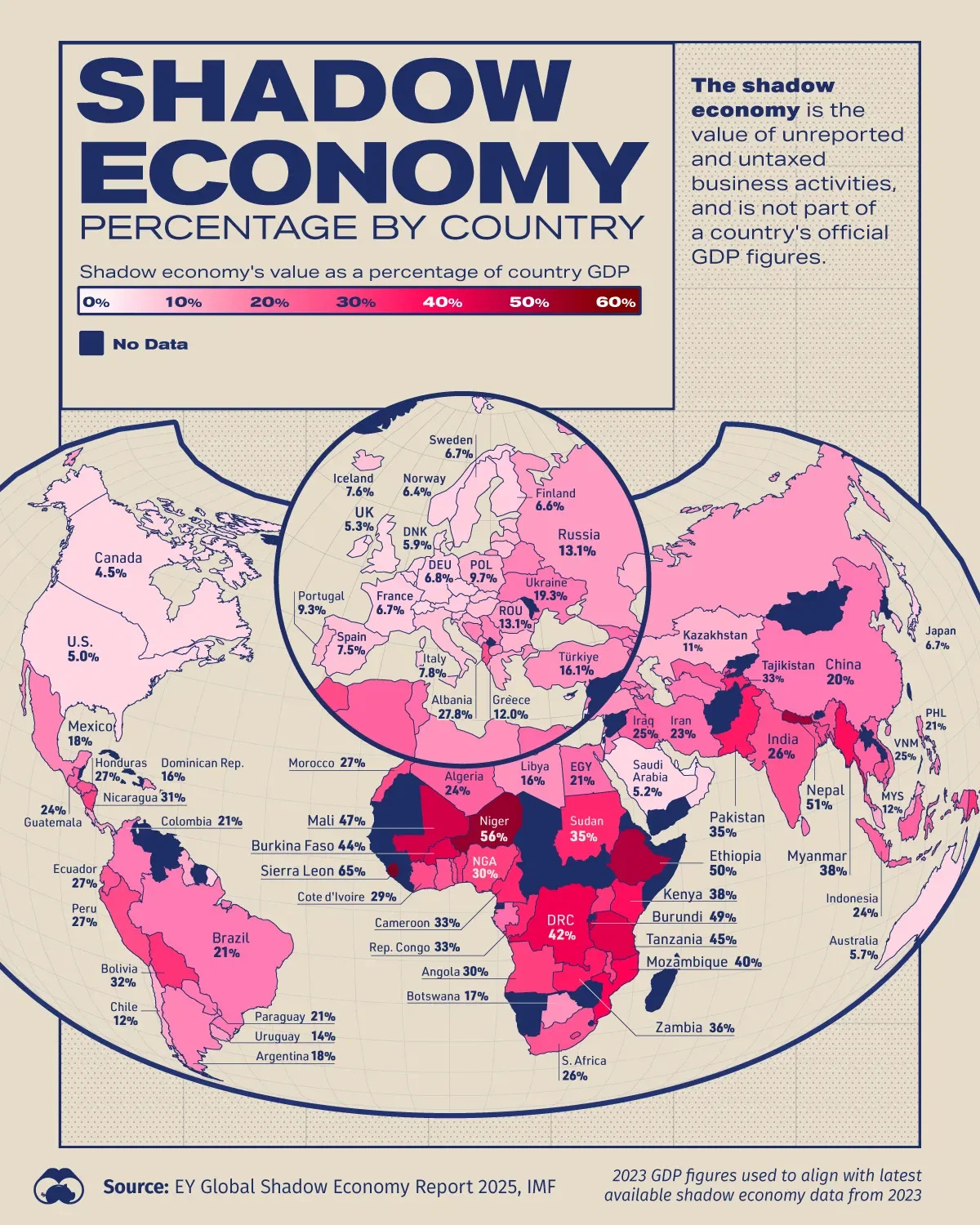
We could spend a lot of time on the shadow economy - and I’m not going to - but Visual Capitalist produced this somewhat fascinating chart of how much of each nation’s economy is “off the books”. It’s sort of instructive as to how much each nation is… well… in control of its own economy and its people.
So that divergence aside, it’s interesting to note where this model sort of doesn’t work well.As you may have noticed earlier, most nations tend to “move up” from resource extraction to manufacturing to a service economy to knowledge work. It’s in some respects a measure of how developed a nation is. But there are notable exceptions, and also importantly, it’s not entirely clear that it’s particularly viable to simply abandon or outsource the “earlier stages” of the economy. Let’s talk about two major points of concern.
Certainly, there’s a great deal of heartburn globally about whether the decision to make China the world’s factory was the correct one - just as there was concern about doing so in the 1970s/1980s for Japan.
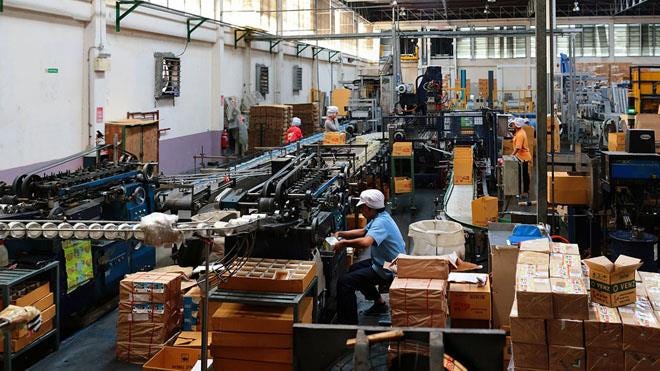
The fundamental problem here is likely not that every nation needs a great industrial base or that one shouldn’t seek economies of scale - but that it’s not economically viable to compete with production costs of building things in China without comparable investment and without accepting a lower standard of living (than the Chinese competitors) while doing so. If you’re trying to build the same products, all other things being equal, you’re going to have a bad day. Could you potentially replicate the same factories someplace even lower-cost, especially as the market for labor in China becomes more expensive? Yes, but there’s significant investment in automation/roboticization in China to stay competitive, so it’s not just a matter of moving production to Vietnam or India for cheaper talent - and you’d need to replicate the entire supply chain, not just the assembly components - because as a rule, the Chinese production process covers a great deal of both primary and secondary economy.
But there’s certain products that nations view as “mission critical” - their term for it tends to be “strategic resources” - things like munitions, fuel, fertilizer, food, pharmaceuticals, personal protective equipment, the sorts of things you need in case of war, famine, disaster, cough pandemics, and all the sorts of things that we all hope don’t happen. But of course they do, and when they do, you don’t want to be at the mercy of some unfriendly foreign power. You want a certain amount of autonomy for things where alliances might shift or fall apart and you need to be able to be self reliant, or else you’re giving a currently-neutral-but-potentially-adversarial third party an unfortunate amount of control over your future existence. So you can’t necessarily put aside your primary and secondary economy - you still need to be able to feed your people, you still need to cover your strategic resource needs in times of crisis… and Europe seems to be learning the hard way at the moment that deindustrialization and a somewhat rose-colored-glasses shift to solar and wind renewables (while also denuclearizing and even removing hydropower, let alone fossil fuel options) leaves them in a rough spot when a Russian political crisis becomes an energy crisis and the Strait of Hormuz promises a matching Persian Gulf energy crisis.
So that sort of brings us to the next major component: not all nations advance evenly (or sometimes even at all) in market sectors - in fact sometimes, they occasionally backslide. The stereotype is that you’ll start off with resource extraction as an agricultural economy (or lumber, or fishing, or mining, or oil if you’re especially geographically lucky) - then develop some level of indigenous manufacturing ability in some niche market that you have aptitude for (for whatever reason - generally because this is what you use a lot of yourself, or because your natural resources are well suited to producing them - e.g. if you have rubber tree plantations you might naturally produce a lot of tires - or because that’s what the market needs at the time so some other nation/major corporation subsidizes buildout of factories, smelters, ports, and railroad / highway infrastructure to not just mine raw ore but actually take that to market as refined ingots of metal owned as a public-private partnership with your foreign investors as well as locals, theoretically this can work out well and not be exploitative… in practice, results vary widely.) And then again in theory, society often moves on from there with more of a service based economy springing up.
But is this how it actually works? Fun fact: no. Most developing nations run on a mix of primary (agriculture or other extraction) and tertiary (trade and tourism - after all, you have to sell the resources you’ve grown or mined or otherwise extracted, and you’ve often got a relatively beautiful/undeveloped piece of the world that people would love to come see). And increasingly, of course, global access to knowledge work has made it viable to participate in the tertiary (and even sometimes quaternary) economy anywhere - thus the rise of digital nomads and job stackers, but also of outsourcing solutions without the traditional brain-drain of elite human capital physically picking up and moving to high wage nations. (Except, of course: medical personnel are still picking up and moving - because medical services take place in person - so a lot of low income countries train doctors and then have them leave the country, which as you might expect is not politically popular.)
But you’ll note: some nations are extremely dependent on resource extraction and are effectively stuck there. This was sometimes called the Dutch Curse (or more broadly, the resource curse) - because it describes the Netherlands' economic decline in manufacturing following the 1959 discovery of the Groningen natural gas field - but similar things happened in 16th-century Spain with American treasure and 19th-century Australia with gold rushes. This may seem unintuitive; a sudden influx of wealth due to success in the petroleum sector doesn’t seem like the sort of thing that would sink the economy, if you buy the theory that a rising tide floats all boats. But in practice, it makes the national currency appreciate, making other sectors like manufacturing less competitive (thus triggering a decline), brain-draining people from those other sectors who move to the higher paying roles in this sector, and otherwise reducing the diversity of the economy.
One should note that the United States is not immune to this either - the tech sector and finance notably attracted a lot of people away from other fields and traditional technology and industry suffered; it was observed that “the smartest minds of our generation were busy figuring out how to make people click on ads” or “constructing financial products for Wall Street rather than inventing scientific breakthroughs” because that paid better. This may have become a little dystopian in the social media era when we were all being turned into little rage-farming screen monkeys to drive engagement bucks and sell ad space, but perhaps I digress. Incidentally, did anyone other than me notice that Facebook (Meta) and Youtube (Google/Alphabet) just lost a multi million dollar lawsuit indicating that they had deliberately made their platforms addictive to teens? Oh, I suppose I’m off topic. Perhaps it’ll be a different article. Back to the resource curse.
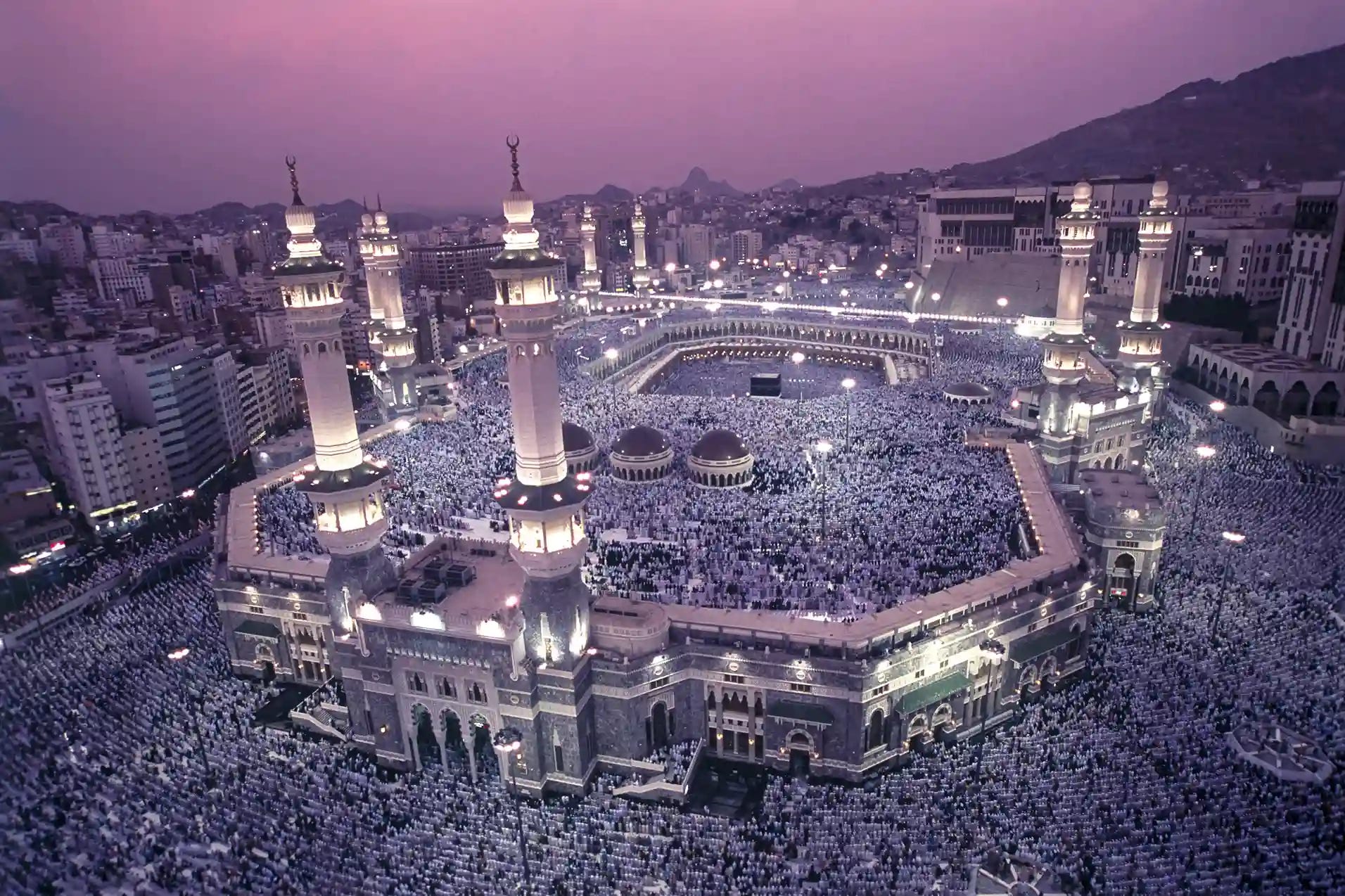
So it’s not just Marvel Cinematic Universe utopian nation Wakanda that thrives on resource extraction wealth with mythical vibranium (nor for that matter far more dystopian Arrakis and its legendary melange spice farming from the Dune setting) - but as you’d expect, OPEC basically all runs on resource extraction. Venezuela, Saudi Arabia, Kuwait - these are all primary economy nations, and to the extent they have secondary economy for export purposes this is mostly refining and processing the petroleum outputs of the primary economy (rather than just exporting raw crude - though that happens too) - as well as manufacturing and construction (for instance, one notes that the Binladen family grew its wealth as a construction empire building infrastructure projects for the Saudi family as the Kingdom of Saudi Arabia developed); Saudi Arabia also has a significant tourism business not incidentally because the holy cities of Islam are there.
Other nations that are generally considered less developed countries tend to have large percentages of their gross domestic product (GDP) from agriculture, mining, or other resource extraction. Burundi and the Central African Republic both are typically around 35% of the nation’s economy for agriculture; Afghanistan, Guinea-Bissau, Sierra Leone, Niger, Mali, Chad, Democratic Republic of the Congo typically have both major agriculture (25-40%) and also mining (minerals, gold, diamonds) adding to the total in many cases. It’s a little harder to say for Ethiopia, Uganda, Rwanda, Malawi, Liberia - but their numbers are not far behind, usually at least 25% and usually closer to 35%. Then there’s areas like South Sudan (oil + agriculture), Somalia, or Burkina Faso - which… due to strife, are difficult to audit. Bolivia and Paraguay, Laos or Nepal might also qualify for high rates - again mostly due to agricultural export. Mostly, this is a combination of limited industrialization and infrastructure, a large rural populations dependent on subsistence or small-scale farming, an abundance of natural resources (minerals, oil, arable land) but weak value-addition (e.g., exporting raw cocoa/coffee instead of processed goods), and vulnerability to what gets delicately called shocks: weather, commodity price swings, or conflict.
Even within this category, though, there’s an unspoken divide, and it should really be pointed out - because it does fundamentally change how society is run. A resource extraction economy runs very differently if it is agricultural (including fishing and lumber) instead of based on mining or oil, which are basically industrial processes these days. (You can certainly make the argument that agriculture can be industrial, and fishing can be industrial, but in most of these countries they predominantly are not.) The key difference is this: if your wealth is pumped out of the ground as petroleum (or mined out of the ground as gold/diamonds/other precious metals-and-minerals) - you mostly do not need your local population and in many cases, if you are of the tyrannical warlord sort of ruler, you can very clearly do without them (heck, you may not even want them - they’re just some more people who might rise up against you). This has led some very oppressive situations and some pretty understandable uprisings over the years as a fabulously wealthy ruling class holds absolute power by controlling the oil fields, the army, and the relationship with international petroleum companies - bringing in foreigners to run the mining or oil drilling operations because the locals are uneducated or because they don’t trust the locals - and there is extremely low value placed on the rest of the nation and the rest of the people who live there. This is not exclusive to oil, of course; this is also the story of “blood diamonds”, nee “conflict diamonds”, and similar struggles for cobalt and other rare earth elements. And it’s not uncommon for the people to rise up - or the army to decide “there’s nothing special about the ruling class, I can take power at the point of a gun” and do so, and especially in the era when the KGB or CIA were busy destabilizing governments left and right (pun intended), bloody struggles for control were all too common - with the people of those nations being generally an afterthought.
But the stereotype is somewhat true - petrostates in particular have been noted for an absolute flood of wealth which tends to produce very affluent sheiks, and then a lot of citizens who have income based on oil dividends. Sometimes this is in the form of a Universal Basic Income sort of setup, sometimes it’s a government “job” with tyranny-of-low-expectations … and generally a lot of foreign workers to actually do the work. Venezuela tried socialism-through-petroleum-riches but this notably fell on its face - Venezuela has the world’s largest proven oil reserves (over 300 billion barrels, more than Saudi Arabia) yet its “21st Century Socialism” (the Bolivarian Revolution under Hugo Chavez from 1999–2013 and Nicolas Maduro since) led to one of the worst economic collapses in modern history that wasn’t an outcome of war. If the world’s biggest spigot of oil wealth couldn’t make socialism work, Bernie Sanders and everyone else should be worried: Venezuela’s oil wealth funded short-term social spending and what’s politely called “political patronage” (or less politely: grift / la mordida), but those same policies destroyed the incentives, expertise, and investment needed to sustain production and diversify the economy. It’s sort of Dutch Disease writ large. And the rest of OPEC watched with great concern - especially amidst the Global War on Terror as the United States military was not exactly shy about intervening around the Middle East - because it wasn’t like the petrostates of the world had a good alternative to transition their economy off oil. Well, except Norway, who had been sensible about how to handle its oil income - and segregated it into what is currently a two trillion dollar fund (the Government Pension Global Fund, aka the Norway Oil Fund - the world’s largest sovereign wealth fund) - largely, other nations have spent their oil income on various temporary activities that amounted to vote-buying or otherwise placating their people rather than investing for the future. Somewhat belatedly, Saudi Arabia and other nations have tried to follow this example with various attempts to diversify their economy and their investments (including things like Vision 2030 building Neom - “the line” - as an arcology city - or buying the Newcastle United football team or investing in Uber)… the jury is still out as to whether this will in fact turn the corner for their economy. Aspirations of building large scale solar facilities in the desert and sending power long-distance to Europe may sound abstractly good, but have some real-world engineering challenges not trivially overcome and for which none of the nations involved currently have the industrial base (one suspects this may turn into a situation where this generated power ends up going to China instead, both because that’s where the solar manufacturing is going to take place and where the demand for power will continue to be; Europe seems to be in a pickle).
Many people have asked over the years in one relatively smug manner or another some variant on the question: what happens when the oil runs out? This can be a literal question of peak oil usage and empty reserves (and nothing more to drill, or at least not to economically drill), or of transition to vehicles and energy generation fueled by sources other than petroleum (whether because the green movement convinces/legislates it or because it becomes economically superior to do so) and though hydraulic fracturing - “fracking” - set that timeline back a ways by allowing petroleum extraction to get more out of oil fields, it’s still a sword of Damocles hanging over the heads of all the current petrostates… who generally have an increasingly large population very used to their comfortable lifestyles dependent on a high-income extraction economy, and, not to put too fine a point on it… are mostly not in any position to survive the loss of their nation’s petroleum revenue. Which tends to mean that the state, and the current royals (or other leaders) are also not likely to survive - the lesson of the fall of the Shah of Iran to a charismatic religious revolution has not been lost on the other Gulf state leaders. But, comparably, the prospect that a strongman might seize power specifically to grab control of oil has been a constant (and justifiable) concern. It happens.
But roughly - it’s difficult for most petrostates to get past primary economy dependency (except inasmuch as their secondary economy is “refining, construction, and infrastructure for export”) and a lot of the tertiary economy that appears to exist is … politely, not particularly robust. It was somewhat famously the case for decades that the Saudi economy was based on export of oil and tourism for the hajj - after that, the next item down was export of … dates. To be clear, this has improved (even if it required some shall we say… vigorous persuasion of some of the Saudi princes to actually take an investment role rather than a dilettante role.) It’s fundamentally kind of hard to get people motivated to work in other fields when clearly the money is all rolling in from oil; it’s often a motivational and educational problem with the population at hand, and the difficulty with a better-educated population tends to be that they want more in the way of rights for themselves and are less inclined to think the current ruling class is doing a fantastic job - they might regard them as squandering the nation’s wealth.
One might reasonably ask how Norway has threaded this needle and not descended into corruption and plundering of the petrofunds for political gain. It’s a lengthy answer, but the short version is: Norway basically discovered oil after building strong institutions, saved revenues in a sovereign wealth fund, and maintained private-sector incentives. Venezuela (and most of the OPEC states) had oil first, then tried to use it for rapid redistribution under weak/centralized governance - or in many cases, other OPEC states held on to monarchy (and fantastic wealth) and bought off their common folk with oil revenues.
One might also reasonably ask how well the various Gulf states are likely to hold up if their oil shipments are paralyzed in the Strait of Hormuz - let alone if Iranian munitions set their refineries ablaze. For the moment, it’s not a cash crunch, these are clearly wealthy governments with a great deal of assets in banks as well as literally in the ground - but there is a very pragmatic concern of “you can’t drink oil and you can’t eat dollars” if the conflict gets to the point that civilian infrastructure like desalination plants and food shipments are endangered. Not something readily solved without trade - and mostly, this trade requires either open sea lanes or open borders, both of which appear to be in doubt. But you cannot reasonably add a primary sector agriculture economy in short order - especially not in the middle of a desert - and while you might want to import food from other nations, the sudden lack of petrochemical-based fertilizers (and pesticides, and other chemical augmentation to farming) may throw a monkey wrench into that plan (as Sri Lanka discovered during its 2021-22 austerity days when it rather haphazardly decided to convert to organic farming, being unable to afford to import foreign fertilizer stock).
In conclusion, while the sectors of the economy are a useful broad classification system for summarizing how a nation derives its wealth, it is still a fairly coarse-grained tool. However, this should at least give you some idea of how this all fits together in the current state of the world - and how the economic incentives drive some of our current world behavior.
Why is that woman drying her face?
So we have good examples of countries dominated by the primary, secondary, and tertiary sectors. There are none I can think of where the quaternary economy is most important, unless you count potential charter cities. And as for the quinary sector, I imagine only the Holy See comes close.