

I’ve got friends in low places
Where the whiskey drowns and the beer chases
My blues away
And I’ll be okay
Yeah, I’m not big on social graces
Think I’ll slip on down to the oasis
Oh, I’ve got friends
In low places
- Friends In Low Places, Garth Brooks
I apologize in advance to Will Martin: this article is not about him.

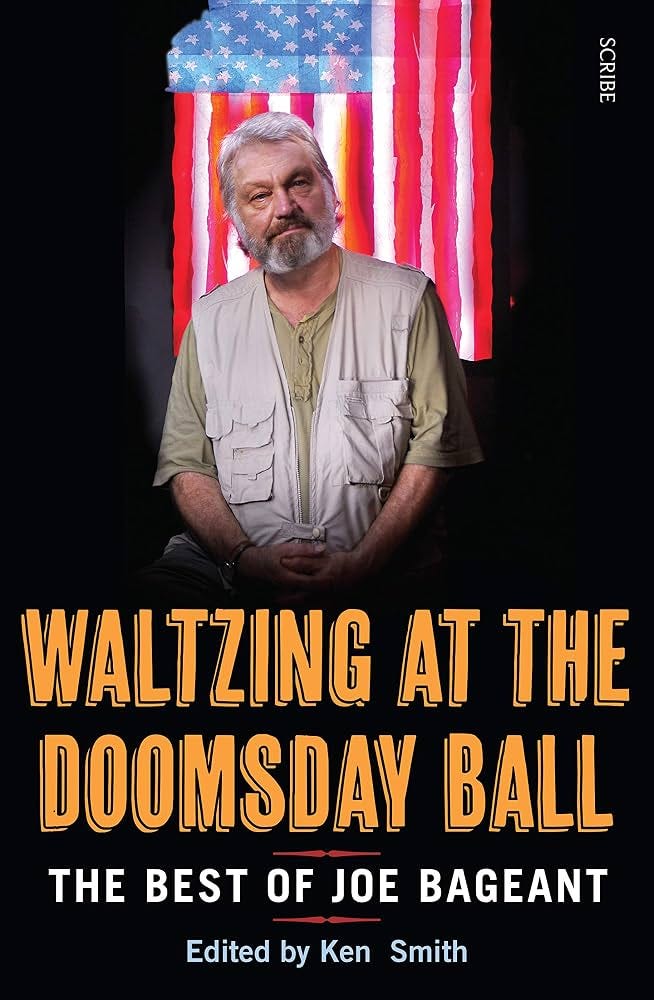
I finally picked up “Waltzing at the Doomsday Ball” - it was apparently not available in the United States for quite a while - and was inspired to write about this incendiary author I used to read online back in the day. Never had the chance to meet him in person - pity; I’d have liked to raise a glass with him. Don’t suspect I could have gone drink-for-drink with him even in the best of my days though.
It’s unlikely you’ve heard of Joe Bageant (pronounced Bay-gent, if it ever comes up) and if you have, it’s likely for his hilariously named book “Deer Hunting With Jesus”. The man wrote angry screeds from the perspective of underclass white folks - self-proclaimed hillbillies and rednecks - from West Virginia and then from Winchester, Virginia. Mostly he focused his vitriol at the “Dubya” Bush regime - this both when he came to prominence in writing, and also shortly before he passed away - and Bageant was at his most hilariously gonzo when he’d channel his Screaming Man persona after a few drinks and really let it all out unfiltered on the page. (If you ever need inspiration as to how to play a Warhammer 40k Ork getting ready for the Waaagh, Bageant in full class-warfare mode is at least the right level of rampage.)
Let’s back up and set the stage a little though. Joe Bageant was an American author, journalist, and social commentator, best known for his provocative, personal, and at least generally insightful writing about class divisions in the United States, particularly the experiences of the white working-class “redneck” communities in rural and small-town America. He was definitely a voice for the downtrodden, eloquent in a certain way that a lot of other people did not ever bother to speak for them. I think in some respects J.D. Vance might have liked him - or at least very much understood him - though the politics were extremely different.
Born on October 5, 1946, in Winchester, Virginia (in the Shenandoah Valley region near the Blue Ridge Mountains), Bageant grew up in a poor, Scots-Irish family with deep roots in the area. He described his background as part of America’s “underclass” or “white trash” - a world shaped by economic hardship, evangelical religion, guns, hunting, alcohol, and a sense of being overlooked or exploited by elites, corporations, and mainstream politics… almost exactly what you might stereotypically expect. After serving in the U.S. Navy during the Vietnam era, he lived a more … let’s say countercultural life for a time, including stints in communes and out West, before returning home to his roots.
His breakthrough came with the 2007 book Deer Hunting with Jesus: Dispatches from America’s Class War, which became a cult favorite among progressives and those interested in class analysis. In it, he returned to Winchester after years away and chronicled the lives of his family, friends, and neighbor - portraying their political conservatism, religious fervor, economic struggles, and anger toward a system that he was pretty clear had failed them. The book blended memoir, journalism, and sharp critique, earning praise from figures like Studs Terkel and Howard Zinn. It highlighted how corporate and political interests manipulated working-class resentment, generally against their own economic interests, and critiqued the cultural divide between liberal elites and rural conservatives. It’s not exactly a complete picture, but he certainly calls out some brutal flaws in the system - and they mostly haven’t been fixed since; things continue to struggle. Mostly, he spends a lot of time blaming Bush - and also the absolute shortsightedness of his Appalachian brethren, which… eh, both true, but neither really makes a particularly complete story, and that’s sort of the tragedy of Bageant’s writing: he likes to find a particular target to demonize and vilify the hell out of it, whether or not it really explains the problem. (The 2008 Global Economic Crash wasn’t quite Bush, was surprisingly not all that much the fault of the banks… who mostly knew better and didn’t want to do these freaking NINJA - no-income-no-job-no-asset - loans … although Bageant would like to draw neat little concentric circles around “the banksters”, and it sure wasn’t the fault of Bageant’s redneck friends who he shakes his head at and tells them they were dumb enough to believe in the pipe dreams they were being sold - whether it was the Global War On Terror/GWOT or mortgages.)
He followed it with Rainbow Pie: A Redneck Memoir (2010), a book which one might call both a more intimate contemplation of his past… as well as of the general downfall of working-class America.
Bageant built a following with his online essays and columns, posted (back then) on JoeBageant.com - now, sadly, defunct. He used gonzo journalism, a style that incorporated humor, outrage, and empathy in his writings. He was affectionately known as “America’s Most Literate Redneck” - I’ll link you some articles, later on - as he showed understanding of both the Southern poor white perspective and the perspectives of the urban and liberal audiences - without being condescending.
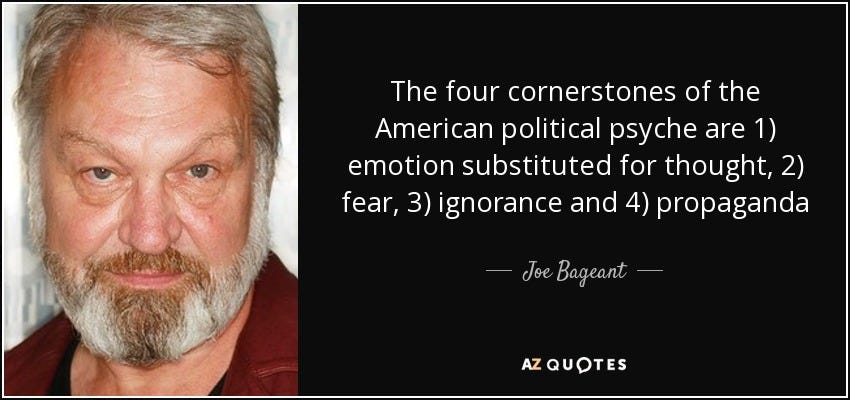
One of his well-known quotes captures his view of American politics: “The four cornerstones of the American political psyche are 1) emotion substituted for thought, 2) fear, 3) ignorance and 4) propaganda.”
Bageant moved back to Winchester later in life with his third wife, Barbara, and continued writing even as his health slowly slipped. At some point, he decided to spend his last couple years in Mexico, soaking up sun and tequila, not necessarily in that order. He was diagnosed with cancer in late 2010 and passed away on March 26, 2011, at age 64.
His writing addresses class, populism, and the cultural and rural divide in the U.S. He provides profound insights into working class America in a manner that highlights and criticizes systemic injustices - and whoo boy, when he gets riled up, does he ever. The strongest aspect of his work is his love and respect for the working class people he profiles - you can tell that he legitimately still feels they’re family, even if probably a fairly dysfunctional family. (I mean… aren’t all families a little dysfunctional?)
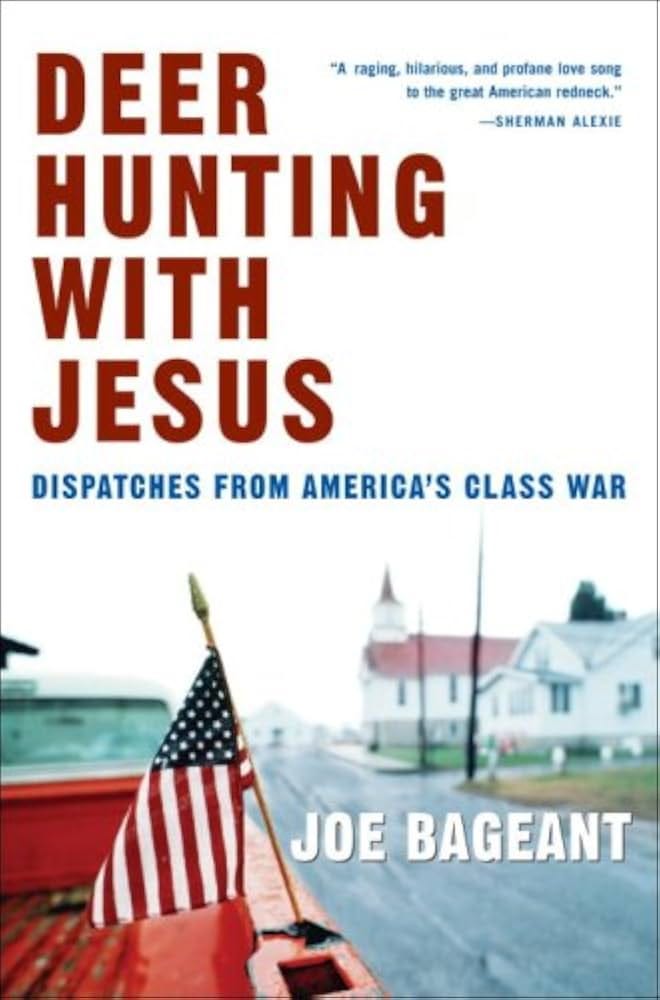
Deer Hunting with Jesus: Dispatches from America’s Class War is a 2007 book by Joe Bageant, written when he had returned to his hometown of Winchester, Virginia, after God-knows-how-many-years away.
The book melds together Bageant’s own experiences growing up working class with observations and reporting on the lousy-with-occasional-silver-linings lives of working-class people in rural America. It explores working class people who are stuck in low-wage manufacturing jobs in places like the Rubbermaid plants, the outsourcing of jobs, unmanageable debt caused by predatory mortgages and credit cards (which he coins “white trashonomics”), as well as inadequate-and-sometimes-no-health-care. In the book Bageant describes how these people use guns, alcohol, fundamentalist Christianity, and NASCAR to cope and give them a sense of identity. He’s a little more compassionate about it than Obama was, though. Bageant generally uses the term “underclass” to describe the bottom third of Americans… to explain the class war that is not being fought on the battlegrounds of politics and the economy but rather in people’s minds: these days, many of them have picked up “deplorables” as a rallying cry the same way that the Stonewall faction moved to reclaim “queer” or “faggot” from slur to term of pride (interestingly though: Bageant’s preferred term of “redneck” doesn’t seem to have made the cut). He argues that working-class people consistently vote against their economic interests, for instance, by voting Republican and for corporate policies, though this is mostly just Bageant’s wishful-thinking of living in the past and thinking that the Democrats are still the party of unions instead of Hollywood or Wall Street or ideology groups… honestly, the Clinton presidency should have shown him better. Bageant critiques how liberals and/or progressives often fail to understand or connect with this “great beery, NASCAR-loving, church-going, gun-owning America that has never set foot in a Starbucks” - isn’t that a great line? Key themes include:
Why the left misreads and misunderstands the working class’s love of guns (and he explains why it’s tied to self-defense as well as Scots-Irish culture)
For that matter, he goes into the border-reaver Scots-Irish heritage (as seen in Lynndie England).
Debt and low-wage economics.
The psychological role of Christian fundamentalism (especially Baptists) and NASCAR.
Although it was written in 2007, it still gets prominent mentions for explaining working class voting patterns, which researchers and analysts still spend lots of talking-head time trying to figure out and pontificate about. Overall, it’s an unflinching, funny, and provocative portrait of the forgotten Americans in “flyover country” and the cultural/political divides that keep them there.
Written with dark humor, brutal honesty, the occasional aw-shucks tenderness, and seasoned one-might-almost-say-liberally with fiery prose, this book (occasionally compared to Thomas Frank’s What’s the Matter with Kansas? or even gonzo writer Hunter S. Thompson) serves as a wake-up call for progressives to grasp why many working-class people feel alienated from liberal politics. Though mostly - that’s an unforced error: the limousine liberals simply detest these people and condescend viciously towards them; Bernie Sanders ran a reasonable populist outreach based on union strengths and class appeal, but the finger-wagging approach of grievance politics is unwelcome, importing a flood of low-paid migrants directly threatens the economic livelihood of this audience, and a succession of Alinsky-focused leaders - Obama and Hillary, at least - focused on city populations and despised the rural audiences: Obama sneered at “people who cling to guns and religion” when faced with job losses and Hillary doubled down calling the same audience “deplorables,” having fled Arkansas for New York as soon as she could.)
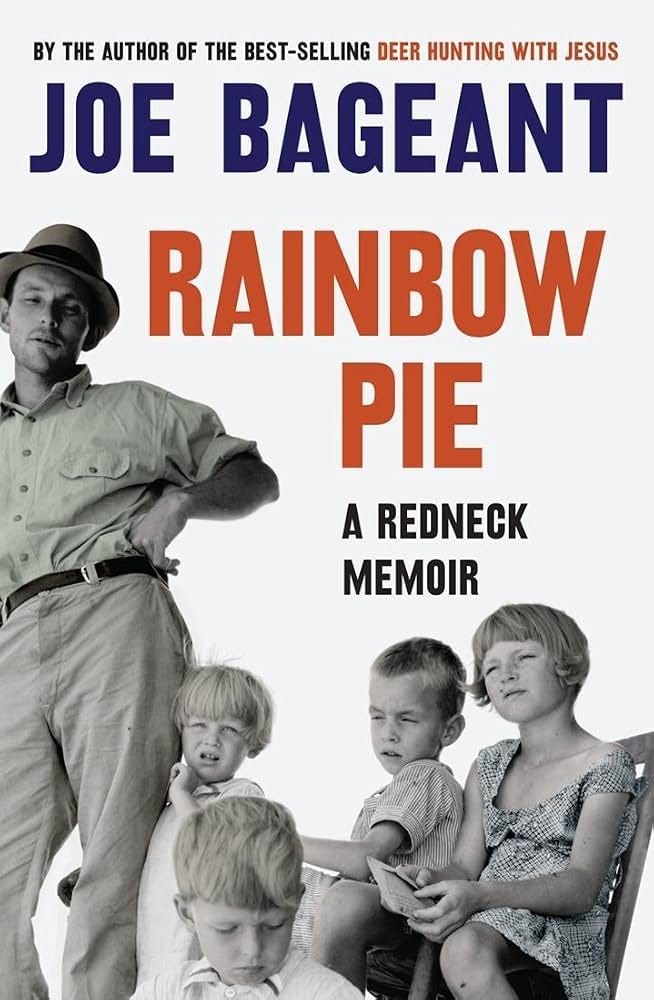
Rainbow Pie: A Redneck Memoir (published in 2010, subtitled A Memoir of Redneck America in some editions) is Joe Bageant’s second book, following Deer Hunting with Jesus. It’s a poignant and biting memoir on class, social divides, and coming of age, all within the lens of the white rural working poor in America, focusing on his roots in the Shenandoah Valley, set in the 1950s and 60s. Bageant uses the rambunctious people in his family (starting with his grandparents Maw and Pap, his aunts like Ony Mae, and his parents) to show how 22 million rural Americans, with the end of the Second World War, left behind their subsistence farming and small town America to work in the cities. Bageant more or less argues that the forces of consumerism, the military industrial complex and corporate farming joined to destroy the rural, self sufficient way of life, and left a permanent white working class underclass.
This one rambles a bit - but probably the key points of this memoir are going to be:
The recollection of self sufficiency, a subsistence way of life, community and family, and what might be best characterized as an independent way of life.
The urbanization of his family, and his father’s working of menial jobs in the factories and living in debt while losing his land.
The critique on how the policies in education and the military (failing rural kids and drafting the poor) lead to an urbanized, meaningless and exploitative way of life.
How a once self sufficient, meaningful way of life became one centered on credit and debt, and how there are increasingly few ways out.
Redneck pride: Bageant shows that rural America is resilient, proud, and funny. He loves reclaiming the term redneck, and if you find that sort of amusing on the face of it - you’ll get his sense of humor. He enjoys humanizing the people he’s writing about, because a whole lot of journalists will happily write them as caricatures to be mocked (since that’s the ideological theme of the moment, and demonizing and dehumanizing people is far easier than understanding them - you see this all the time from journalists who wail “I can’t understand why someone would vote for Trump” but clearly have never spent thirty seconds thinking about the person or their situation, they’re too busy trying to performatively sneer and spit at the family members they want to preemptively disown.)
While he’s clearly nostalgic for what was lost (the world of storytelling, mutual-aid, and camaraderie-sitting-on-the-front-porch)… mostly this book is marking the passing of this culture and Bageant’s anger at the powers-that-be (he mostly blames capitalism and government intervention, then continued capitalism and government neglect) for doing this part of the country in. This particular book is much less about contemporary politics than Deer Hunting with Jesus was (though it connects to similar themes of class alienation), and more on historical/economic forces that shaped the white working class he knew.
You won’t be surprised to learn that people who liked this book loved it for Bageant’s heartfelt writing - as ever, it’s his emotional depth and his skill with prose that grabs you, though the man is better with analysis than you’d probably initially think. The book is profoundly melancholy and hilarious at turns, with not a lot in the middle - you’ll definitely get a bit of whiplash reading it - but if you’re up for a bit of an emotional roller coaster reading about inequality, cultural loss, and the human cost of “progress” - this book may make you profoundly irate with how a whole lot of Americans are neglected. Bageant holds them up and says they’re forgotten Americans sacrificed to the “fetish for commodities” - and … that’s, I suppose, part of the whole debate about offshoring significantly all the traditionally American manufacturing first to Japan and then to China. As you might expect, he’s not very pleased with how Wal-Mart and similar corporations exploit the American underclass. And … he’s not wrong, as far as he understands the problem, but he didn’t particularly get what was going on beyond the street level or why things were happening the way they were, which is why it had to be so infuriating for him. Cue the Screaming Man!

And then the one I just made my way through, Waltzing at the Doomsday Ball: The Best of Joe Bageant (published posthumously in 2011) is a collection of 25 selected essays from Joe Bageant’s online writings, edited by Ken Smith (who managed Bageant’s website and helped share his work). Bageant, who - as mentioned above - had died in March 2011 at age 64, had published 89 essays online starting around 2004, when he discovered the internet’s freedom from mainstream media gatekeepers. Ahh, the good old days. One might think he would have joined us here on Substack and we would have had some famous brawls.
This collection of (what’s claimed as) Bageant’s finest work presents his inimitable voice: raw, profane, humorously dark, and compassionate. Often addressing the neglected white working-class in America (sometimes depicted pejoratively as “rednecks”) Bageant has the refreshingly self-aware honesty to say: “this was a taboo subject in the liberal media” - no kidding, my dude, Appalachia has been absolutely memory-holed.
Essential themes of Bageant’s body of work include:
America’s class divide; tens of millions of white American working and poor classes that are willfully ignored by the elites on the coasts and in the media.
Fundamentalist religion and consumerism coupled with low paying jobs and a cultural escapism of drinking, football, and NASCAR which leaves the working and poor classes politically exploited, voting against their economic interests.
Critiques of America’s corrupt and decadent (but profitable) empire and corporate domestically and abroad.
Bageant personally reflects on escaping to Belize to find cultural tolerance, the absurdity of our “shithouse rat” led society, and “pathological misfits” (preachers and politicians).
Writing tequila-fueled takedowns of culture and politics, Bageant presents emotional and compassionate portraits of his rural Virginia and West Virginia peers, against which he highlights a glaring absence: the Democrats’ “do nothing” policy.
Bageant’s last book is a chilling account of a broken country (one shouldn’t be surprised - he wrote much of this during the Great Recession courtesy of the 2008 Crash), and an appropriate culmination of his work. It is best described as a searing collection of essays on American society; a greatest hits of his blog, presenting much of Bageant’s voice in one final volume, for fans who appreciate his journalistic style. While it is an invaluable collection for his long time followers, some note it can feel scattered, or repetitive if you’ve read his earlier books. The man’s like that - this is a collection of blog posts, he’s mostly editorializing.
The title evokes a grim, ironic dance on the edge of societal collapse—waltzing toward doomsday amid denial, distraction, and division. Overall, it’s a passionate, unfiltered indictment of class denial in America, delivered with Bageant’s trademark ascerbic wit, affection for the forgotten Americans, SCREAMING MAN OUTBURSTS, and refusal to pull punches.

As I mentioned earlier, Bageant is sometimes compared and contrasted with J.D. Vance (especially when Vance was basically known for Hillbilly Elegy and not for being the Vice-President). They are both writing about Appalachia, though separated both generationally - Bageant is far older - and Vance is far more eager to bootstrap and overcome where he came from, whereas Bageant sort of focused on “his people” even when they mostly thought he was a damn pinko. (I was always sort of curious how that went down - I gather, not always well - but that probably wouldn’t have been the sort of story he wanted to write about.)
So … broadly, and discounting the endless online writings or syndicated pieces: Joe Bageant’s writings (primarily Deer Hunting with Jesus (2007), Rainbow Pie (2010), and the essay collection Waltzing at the Doomsday Ball (2011)) get matched up with J.D. Vance’s Hillbilly Elegy (2016) and we’ll just…. go ahead and leave Twitter and such out of this, shall we? Both authors explore the lives, struggles, and political attitudes of poor and working-class white Americans, particularly those with rural, Scots-Irish/Appalachian roots. They emerged in different eras—Bageant’s during the George W. Bush years and the early financial crisis, Vance’s amid the 2016 election and rise of Trump—and are often compared as windows into the “forgotten” white underclass. Readers and reviewers frequently recommend Bageant as a deeper, more class-conscious alternative or companion to Vance - let’s be fair, Bageant isn’t really trying to sell you something nearly as much, and Bageant also has a lot more experience at writing so he comes across with more structural critique of the cultural situation and also more empathy for the people he’s writing about rather than… well, Vance kind of seems like he’s chronicling how he survived them.
Similarities:
Subject matter: Both examine communities in the rural, white, working-poor population trapped in cycles of poverty, debt, and job instability. Both document the role of the church, religion, and behavioral escapism (alcoholism and NASCAR) as a means of coping and escapism.
Personal roots: Both Bageant and Vance return to their home turf to document the people, places, and politics of their communities. Bageant returns to his hometown of Winchester, Virginia after 40 years, and Vance details his family and upbringing in Middletown, Ohio (Kentucky) and Appalachia.
Politics: Both describe the reasons people of their communities vote Republican (or against their economic interests), feeling abandoned by elites, liberals, and the Democratic Party.
Cultural description: Honky-tonks, family chaos, religious services and self-reliance, and resentment of outsiders, particularly “coastal elites.”
Key Differences
Well, pretty fair to say Bageant’s work is more politically radical - but also, more compassionate to the Appalachian community… while Vance’s work is more “pull yourself up by your boot-straps” and moralistic.
Perspective and Tone:
Bageant is the rare example of the “redneck leftist” - he is a class warrior, raging against the corporate exploitation and system that leads to debt, chronic conditions, suicide, and economic hardship. He is deeply empathetic toward his people, never smug or condescending, and critical of systemic inequalities and oppressive structures. He treats “rednecks” with dignity and pride.
Vance’s memoir is largely a personal success story. He offers his criticism of “learned helplessness” and other cultural failures of his community (such as impulsiveness and violence) along the way. Some consider his work smug and self-serving. It tends to individualize and blame families and communities rather than systems, and can sometimes be judgmental.
Bageant, on the other hand, individualizes and blames families and communities far less and, in fact, castigates Hillary Clinton for her infamous comments about the cultural failure of children and families (as opposed to the system) that resulted in the loss of the family farm, the closing of the factory, etc. Bageant criticizes globalization and consumerism and the liberal elite for their willful ignorance of the White working class, and defends those who vote Republican as not being dumb. In fact, he says, many working-class White people understand perfectly what they are doing when they vote for a Republican, and it isn’t dumb: at least the Republicans are looking out for some of their interests, as opposed to none.
As for Vance, while he references the economic failures of the region, he largely focuses on cultural failures, such as family instability. He criticizes over-reliance on government aid and advocates for personal responsibility. Overall, Vance’s focus tends toward the personal, and culture and values, rather than politics and the economy. Which… may not be what you would have thought. Though, arguably, he shifted some of his positions after this book was published.
Vance’s book was popular across the political spectrum at the time. Liberal readers were particularly drawn to the book to “understand Trump voters.” However, Vance later shifted to the right, endorsing Trump and becoming a Senator, before eventually being chosen as VP. Some criticize Hillbilly Elegy as reinforcing right-wing, personal-responsibility myths, while defusing the power of large corporations.
The style and focus of both books vary. Bageant’s books are class analysis and gonzo journalism; Vance’s book is more of a personal narrative of triumph and less of a class analysis-except-as-backdrop, with a cultural diagnosis as a secondary focus.
Bageant has more systemic critique and rage, but Vance is (surprisingly) less academically dense and more accessible. People who focus on class and systemic critique in literature will undoubtedly prefer Bageant, finding that he writes more lovingly and authentically for his community, with less of an air of superiority… and there’s no inkling Bageant has political aspirations, so people always look at Vance a little dubiously by comparison.
If you’re interested in uncovering systemic rage and class disaffection, Bageant and Vance are both actually going to do it for you - just from a different perspective. Bageant is hailed for his grim literary critiques and his rage hits harder; Vance is commended for his emotionally charged positivity and narrative focus - he tells the story more effectively end-to-end. Ultimately, they’re both worth reading, for different reasons - but this post is mostly a paean to the Screaming Man.
He wrote a handful of excellent articles before he went - I’ll link you a couple of them here, but you can find others at this link (they’re sometimes dated, but the man’s still got a flair for words… and a frothy temper)…

“America: Y UR Peeps B So Dum: Ignorance and Courage in the Age of Lady Gaga”

“America’s White Underclass: When seeing ain’t believing, someone’s blind”
I’ll leave you with his hilarious piece - in the BBC, no less: “Why rednecks may rule the world” - it dates from 2008, and it’s mostly tongue-in-cheek about Sarah Palin.
I’ve never been to Arkansas but of all the things one could accuse Hillary of…I think this makes me like her more.