

The First Amendment gave us freedom of speech
So what you sayin', it didn't include me?
I like to party and have a good time
There's nothin' but pleasure written in our rhymes
I know you don't think we'll ever quit
We've got some people on our side who won't take your lip
We're gonna do all the things we wanna do
You can't stand to see a brother get as rich as youBanned In The USA, 2 Live Crew
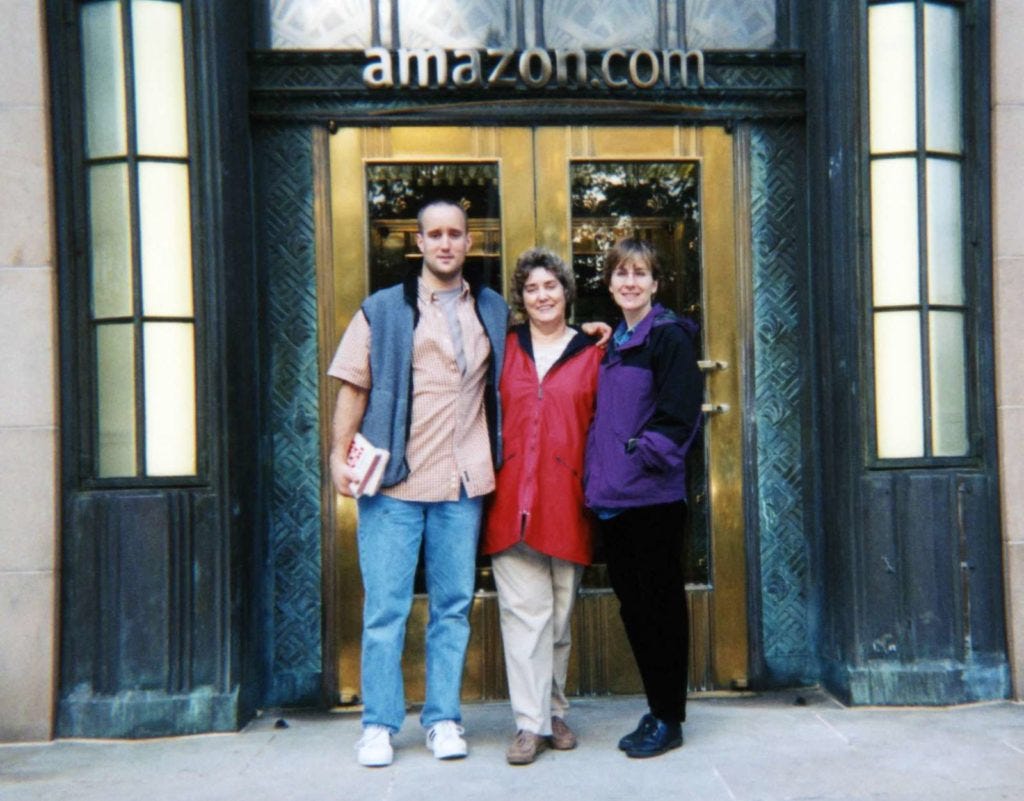
I have related enough anecdotes about the ancient days that some of my readers will know that I sold my first company to Amazon quite a while ago. Though this was a tremendous experience - in the sense of learning a lot and changing my life, it also gave me a lot of interesting war stories from that firm’s early days and some of the guiding decisions that shaped its cultural zeitgeist to this day.
So I’m not here to talk about the curious experience of being unable to refer to senior executives as “Jeff” - there were too many of them, what with Jeff Bezos (of course), Jeff Wilke, and Jeff Blackburn all at the “S-Team” level of senior management. That’s not censorship so much as just an attempt to prevent confusion. Likewise, I’m not trying to reference the giant prehistoric cave bear skeleton that Jeff Bezos had acquired as part of one of the Amazon Auctions partnerships with Sothebys - which came mounted on a fully posable steel frame, and which was displayed in the front entrance of the PacMed building that was Amazon’s headquarters for several years. Why would that be censored? Well, it was … fully posable, and complete. And people would indicate whether the stock price was up or down for the day by adjusting the angle of the cave bear’s phallus.

When this was relocated into the new Amazon offices it may have been quietly neutered. (And as I recall there’s a “Don’t feed the bear” sign.”)
Anyway, no, that’s not what I had in mind. Though someone did at one point put up the inevitable Star Trek callback to Commander Data being “Fully Functional and Anatomically Correct.” That particular poster did not last long.

There’s currently a kerfluffle on social media about Jean Raspail’s 1973 book Camp of the Saints, which has been out of print for quite a while but was somewhat recently republished. I’ll get into why in a second, but the short version of the story is that it was available on Amazon (like basically everything else on the planet is), then it was banned from sale, and now it has apparently been reinstated and is charting high due to a phenomenon generally referred to as the Streisand Effect. (So named because of Barbara Streisand’s 2003 lawsuit attempting to suppress photos of her Malibu home and her name being attached to an expose about cliffside erosion - until the lawsuit, she had lived in luxurious semi-anonymity except for the Maps-to-the-Stars crowd; after that, the world knew about her.)

It was a rather boutique firm named Vauban Books that had put Camp of the Saints back into print in English. They specialize in translations of French literature (and indicate a desire for other European literature) that don’t otherwise make the mainstream audience. Fair enough.
But this particular book had been decidedly mainstream in its day; Ronald Reagan was familiar with it, having been given it by Alexandre de Marenches, the head of the French intelligence service SDECE.
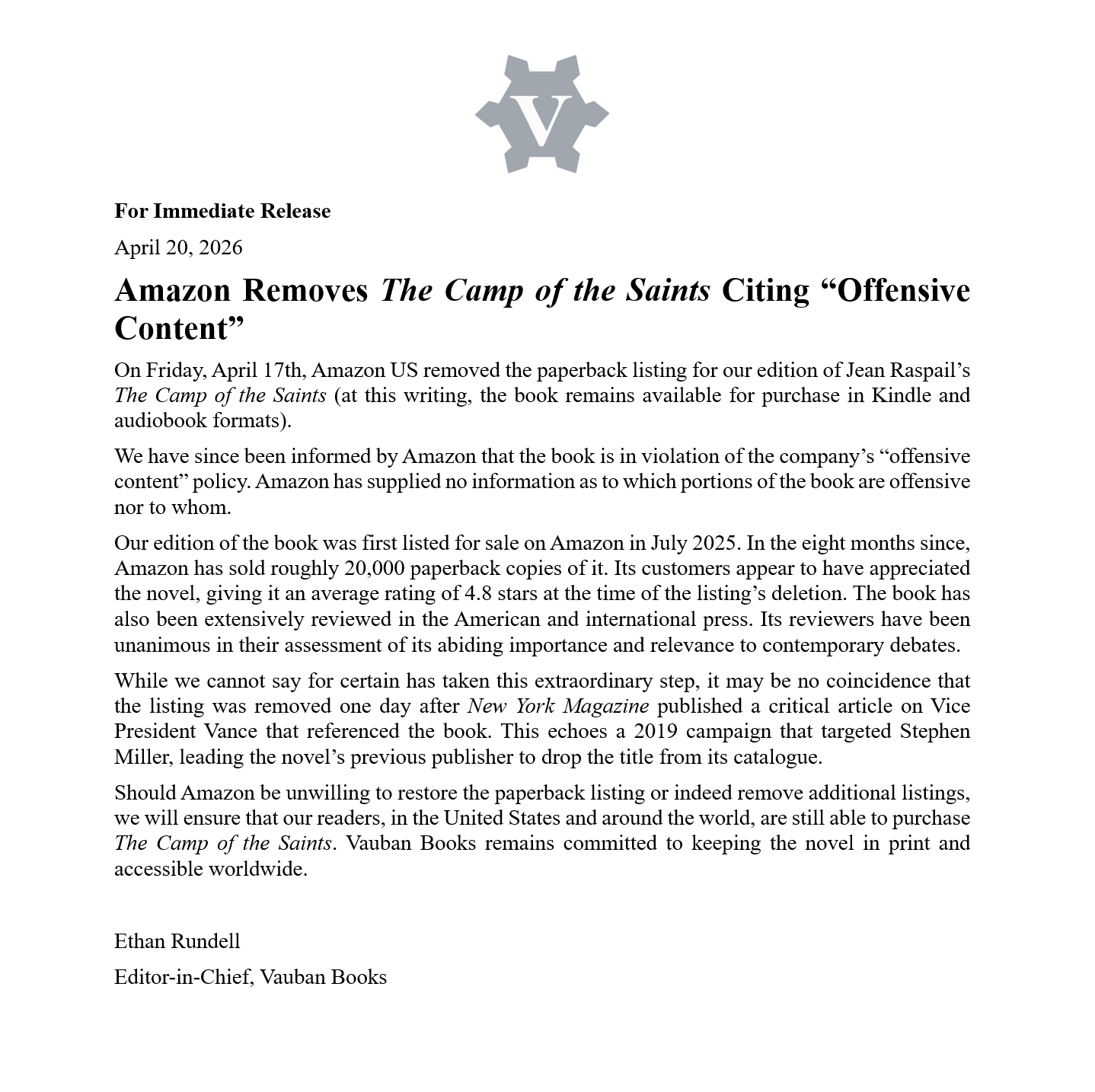
Two days after the above press release - without further explanation other than “it was an error” - Amazon re-added the book to its Everything Store.
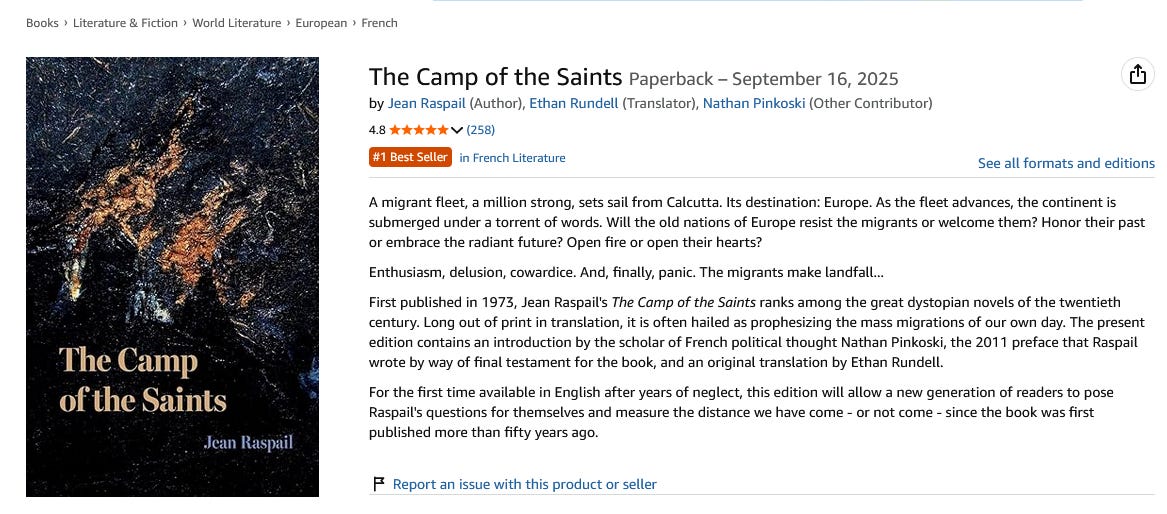
It is currently the #1 Best Seller in French Literature.
Let’s be fair. It is very French, even when fully translated. It is a great deal of build-up with very little denouement. The characterization is … well, at best uneven, one might charitably say that only the French characters have any character development and the Indian migrant hordes are basically faceless, implausible, and grotesque. It comes across as extremely fatalistic, postmodern, and nihilistic (and yes I can hear you saying “But you already said it was French.”) It is evocative. It sets a mood well… and it is not a pleasant mood. It may in fact have been a relatively insightful view of where a self-absorbed and self-hating Western culture would go. Though I think perhaps the assimilationist view does at last clash with the nationalist view and perhaps all is not as preordained as this book might have foretold, c.f. National Rally.
(a later editing pass on this showed that it had moved to “#1 in Emigration and Immigration Studies” which, I suspect, is not what the other inhabitants of that category would like.)

So, Amazon sells a controversial book - so what? Well, this is not the first time, and it was rather famously a topic of great controversy Back In The Way - even more so than the aforementioned ice age cave bear. You see, the first time this came up at an all-hands meeting, the book in question was even more controversial and not generally viewed as a culturally defining work of literature or an expressive piece of national ideology (except perhaps inasmuch as one might call it a piece of nationalist ideology) - that book was the somewhat infamous Turner Diaries.

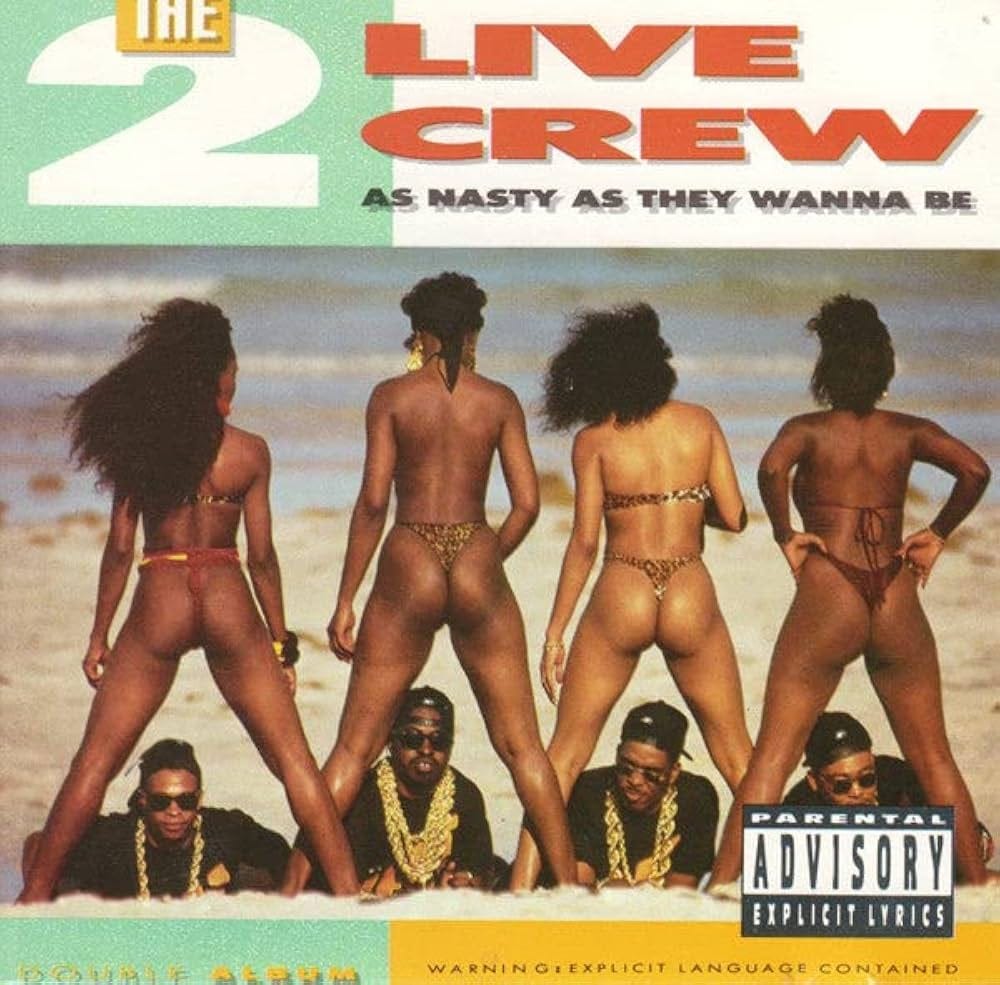
Amazon sold it with this cover. (Which I suspect ended up being a little like putting the “Parental Advisory: Explicit Music” sticker on CDs/record labels back in the day.) And in 2000, there was a good bit of concern: Should we really be selling this?
See, for those of you who haven’t read this - and I’ll assume most of you haven’t - the Turner Diaries are a story by a fellow named William Pierce, written as a serialized novel back in 1978, under the pen name of Andrew Macdonald. It’s told in the form of a series of diary entries by the protagonist Earl Turner, who is a disgruntled electrical engineer working for a revolutionary group called the Organization - a white supremacist group trying to overthrow a sclerotic and corrupt United States which is in turn subverted by all the usual boogeymen that you’d expect from being written in the 1970s (Blacks, feminists, Communists, homosexuals, any sort of foreigners - it feels a little bit like the old Jack Chick tracts in some strange and morbid fashion except that no Bible quotes ever seem to materialize) and it puts them all under the command of Jewish puppet masters, who pull the strings for world domination. It is quite an apocalyptic story - the grand downfall of the “the corrupt world” and the extremely bloody rise of the “new world order” - and though it probably went over well with the particular audience of white nationalists he wrote it for, I wouldn’t have thought it was ever mainstream enough to matter. (The Blues Brothers making fun of Illinois Nazis probably got far more mindshare… except… well, let me come back to that.) And really… if it wasn’t for all the controversy, no one would remember this book, it’s really not very good. It and a sort-of-prequel named Hunter (by the same author) were popular with a bunch of edgelordy types - one of whom had back in the day foisted these off on me along with a bunch of Norwegian black metal music from Burzum (yes, that dude: Varg, infamous for stabbing Euronymous and burning churches, real class act) and Emperor - but like a lot of novels of this sort, it was just not very well put together.
It was very curious watching Jeff Bezos stand up in front of an all-hands meeting in the vast auditorium and speak vehemently about why it was the right thing to do to sell this book. Jeff’s perspective was very Libertarian: Amazon should sell basically anything - he, as I recall, said “well, except maybe the Ebola virus.” Someone asked dubiously: “Would we sell cement?” thinking obviously that shipping costs were causing enormous heartburn for Pets.com and many other companies in the e-commerce space at the time. Bezos had in fact thought of that, and postulated a system whereby one might order a delivery of a cement pour and have it queued from delivery from a fleet of local cement trucks that would drive up and deliver it, possibly even already orbiting the streets and servicing construction spots in your metropolitan area - they needn’t be Amazon trucks, precisely, just that Amazon would connect you to the local cement vendors and arrange for delivery of however much you needed to have your foundation poured.
But attention quickly swerved back to the book, because people were concerned that it was promoting dangerous ideas. I wondered to myself: had he read it? Had the people in the room who wanted Amazon to pull it from the storefront? Would they care that we sold the Anarchists Cookbook, or Poor Man’s James Bond, or other improvised-weaponry books? Or the various other call-to-revolution books from the various other factions on other points on the political spectrum (eg Che Guevara’s book Guerilla Warfare, or inevitably Mein Kampf, or Ted Kaczynski’s writings - ironically available for purchase through the internet). Amazon didn’t sell guns - but we’d sell you a book on how to make one at home, or how to make a silencer (and as I recall, Paladin Press put out all sorts of controversial books at the time, some of which were utterly implausible).
Well, mostly what this came down to is that Timothy McVeigh had read it. And some people thought the book had one-shotted him. (They didn’t use that term; it didn’t exist at the time, but the sentiment of memetic contagion was there. McVeigh cited the reason for his radicalization as being the government massacres at Ruby Ridge and Waco - but did cite his inspiration for the Oklahoma City bombing in particular as being Pierce’s writings.) Now, this was to shortly be eclipsed by 9/11, but the Oklahoma City bombing of the Federal Building back in 1995 had been the most notable terrorist incident on US soil - especially since the first attempt by Al-Qaeda to blow up the World Trade Center had been foiled - so it was still something that people had Strong Opinions About. And it might not surprise you that these were often fairly politically coded opinions because McVeigh pretty much thought Bill Clinton and/or Janet Reno were the Illuminati or the Anti-Christ and were out to oppress and destroy all that was good about America, and had decided to violently oppose this. (A sentiment I encountered again reading, of all things, Tara Westover’s biography Educated and her chronicle of growing up homeschooled.) But this did not at all suit Amazon’s core employee base of urban blue-state affluent urban professionals, who predictably had the relatively left-coast mindset (to be fair, a bit more even-minded than some of the other tech community, at least in those days, but it’s been a while…)

Amazon eventually did yank the Turner Diaries from sale in late 2020, apparently along with a number of other things related to QAnon - or so says the New York Times; I couldn’t actually find a list of what was purged. Bezos didn’t intervene this time, and certainly once Biden was firmly in power (and in the wake of January 6th) was no time to ruffle any feathers by reversing that policy. They had seen which way the political wind was blowing. Nobody has raised enough of a ruckus to get it reversed since Trump was re-elected - and really, I’m not sure who would; the question usually is “who would benefit from it” and unless someone’s likely to sell a truckload of books, it seems an unlikely cause to get exercised over. But every now and then people get agitated just to raise controversy, so if an army of Groypers start demanding the Turner Diaries I suppose I wouldn’t be entirely surprised. If it’s a 2 Live Crew reunion tour… well… politics has strange bedfellows. I hope Tipper Gore introduces them on stage.
Thanks! Vere educational!