

In my thoughts I have seen rings of smoke through the trees
And the voices of those who stand looking
Ooh, it makes me wonder
Ooh, really makes me wonderAnd it’s whispered that soon if we all call the tune
Then the piper will lead us to reason
And a new day will dawn for those who stand long
And the forests will echo with laughterIf there's a bustle in your hedgerow, don't be alarmed now
It's just a spring clean for the May queen
Yes, there are two paths you can go by, but in the long run
There's still time to change the road you're on-Stairway to Heaven, Led Zeppelin
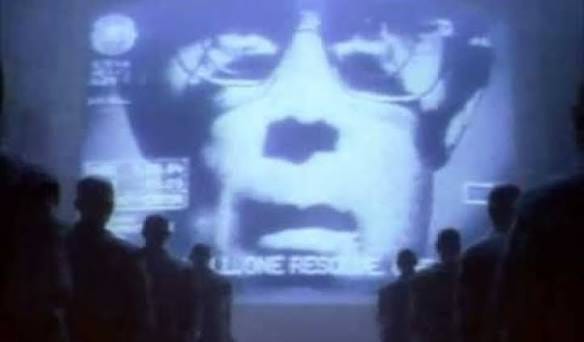
"Today we celebrate the first glorious anniversary of the Information Purification Directives. We have created for the first time in all history a garden of pure ideology, where each worker may bloom, secure from the pests of any contradictory true thoughts. Our Unification of Thoughts is more powerful a weapon than any fleet or army on earth. We are one people, with one will, one resolve, one cause. Our enemies shall talk themselves to death and we will bury them with their own confusion. We shall prevail!"
Wait… remind me which side Apple was supposed to be on, again?
The rise of China’s tech sector was enormously supported by Apple, to an extent that will likely amaze and daunt you. This was both literal cash (and machinery) investment, enormous revenue and hiring commitments, and perhaps more critically - the skills and knowledge necessary to build the supply chains necessary to make everything run smoothly. Tens of millions of people would flood into factory cities every year to build iGadgets to feed the world’s appetite for the latest and greatest innovations from Apple, whether this was the iPod, the iPad, the iPhone, or the various flavors of Macintosh, Airpods, or Apple Watch (or if not to literally build them, then to supply the componentry that was used to construct them - the logistics of fulfilling all this was prodigious).
Apple has been for some time putting upwards of $50 billion a year of investment into Chinese manufacturing so that various firms - initially Taiwanese firm Foxconn, but soon enough mainland firms such as Lens Technology and Biel Crystal who make the glass for your smartphones, watches, and tablets - could build the infrastructure to build iPhones, iPads, and Macintoshes. Similarly, significant investment has been made by the government to subsidize growth of these firms, giving them enormous advantage over their Western competitors. Combine this with the (traditionally) lower wages and longer work hours of the mainland and Taiwanese regions of China, their significantly larger labor pool and less worker-protective laws, and the availability for several large regions like Shenzhen and Pudong classified as “special economic zones” where capitalism has more free reign and where taxation is less burdensome… let alone bureaucracy, permitting, and environmental law… and you can see why the cards were increasingly stacked in factor of moving all your manufacturing to China. The fact that you could, in general, have access to whatever you needed in your supply chain at “China speed” - having it delivered from across town from another vendor in Shenzhen in an hour or two, rather than waiting weeks - meant that there was also de facto vertical integration available near at hand. It became painfully evident how much this had hollowed out American manufacturing when Apple tried to showcase an attempt to return some Macintosh manufacturing to the US (in 2019, as a showcase photo op for Trump, with the Flextronics facility in Texas, which made Mac Pros).
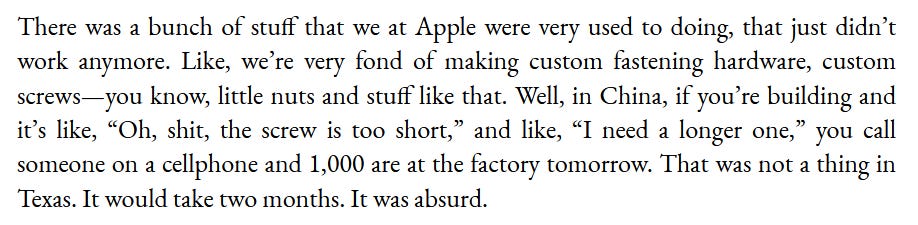
In the end, Apple had to bring Foxconn people from Taiwan to Texas to get that plant operating at the standard that they had become used to; Apple had closed its American factories only a decade earlier but a great deal of knowledge had been learned (and probably also, lost) during that time.
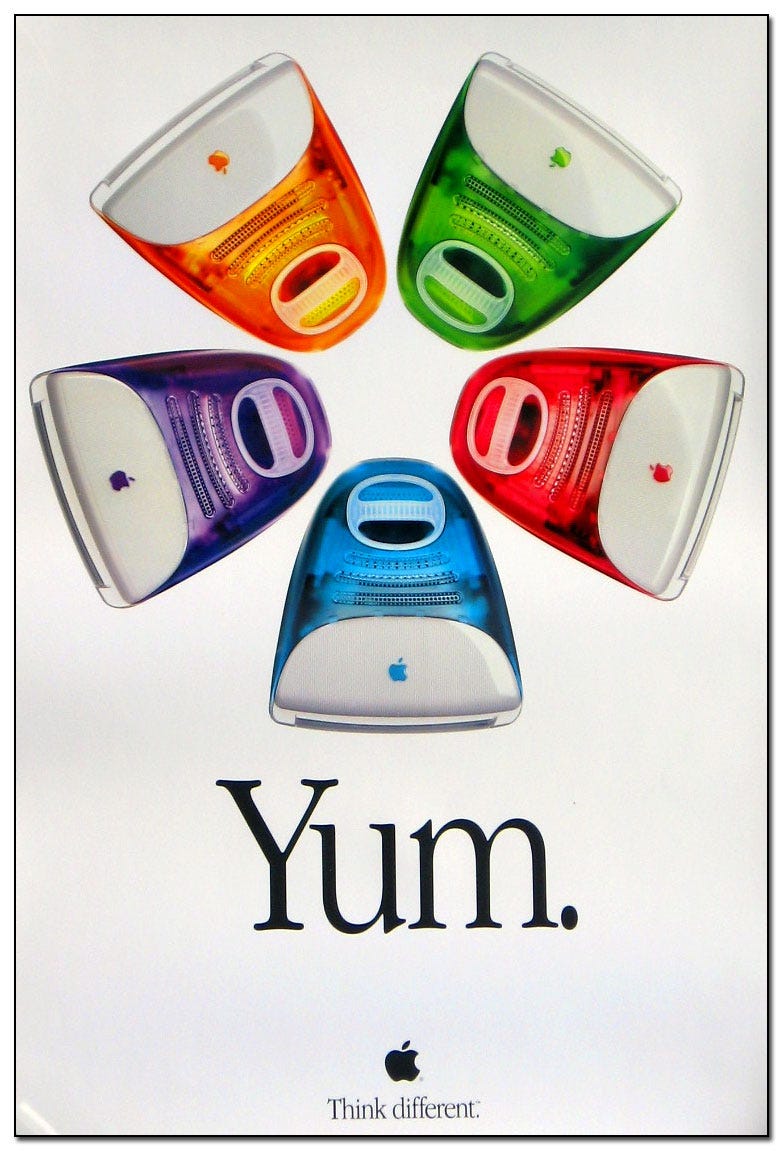
Apple also had a policy that no vendor could be more than 50% revenue-dependent on Apple, so they encouraged all these suppliers to establish relationships with other firms locally, thus spurring the growth of the smartphone industry that would build endless Android clones for the China market and for export as well. (This policy came about after Apple inadvertently killed off several firms by being the primary customer for nearly all their manufacturing capacity, and then changing one component or another of their design to no longer use a particular part - thus obviating the need for that product, and putting the supplier out of business - tremendously bad PR for Apple.) As it turned out, this led to the growth of very effective competitor Huawei (also, Vivo and Xiaomi, plus Chinese firm Lenovo bought Motorola’s cellular business and IBM’s laptop business) - which began taking market share from Apple in China, largely killed off the other smartphone vendors other than Samsung, and then expanded internationally. Soon, Taiwan’s HTC and Korea’s LG were basically defunct, as were once-giants who had owned the space like BlackBerry or Nokia (once the pride of Finland); and global sales of Google Pixel are - to my surprise - still so low as to be a rounding error, that device is roughly 1% of the market and about 7% of the US market.
Huawei might have eaten Apple’s lunch sooner - it certainly seemed about to do. But two things intervened, both rather black swan events. The first was Trump’s wild card responses - Apple was cautious about him, thinking he would overturn their delicate relationship with China, but his concern about possible espionage and sudden sanctions torpedoed Huawei’s push into the 5G cellular market right when Apple was trying to launch their iPhone XR; this gave Apple a tremendous economic success for several years while Huawei regrouped. And the second, of course, was COVID and the ensuing global economic disruption from the pandemic. Apple was better positioned than most to navigate this - partially because the Chinese government took this opportunity to conduct various purges of their own tech sector - until the 2022 shutdown of Shanghai left Apple in the lurch for months and made them realize how much they were at the mercy of the PRC.
It turns out that Tesla has followed the same path starting in 2016 - both permitted to succeed as a foreign firm and then swiftly cloned-and-improved, which is why BYD has emerged as a phenomenal car manufacturer now.
But think about that amount of investment. The much-ballyhooed CHIPS act allocated $52.7 billion for semiconductor manufacturing (over several years) as well as large tax credits for public sector science, R&D, and the somewhat more amorphous “social and ethical considerations, workplace development, and diversity, equity, and inclusion efforts”. This 2022 initiative was intended to be an enormous transfusion to preserve competiveness in the technology sector as far as manufacturing chips and electronics domestically; it was less than Apple spent every year in China. As of 2015 Apple was injecting $55 billion a year into China as investment - not wages, not cost of goods, those are over and above; this was new buildout in China, new factories, new machinery, new supply chain, new investment. There were 1600 suppliers subsidized and equipped by Apple in order to make the iPhone supply chain run efficiently. More than half a trillion dollars every decade went to building the Chinese tech industry - just from Apple alone. It’s no wonder they dominated.
Now, by comparison - Walmart sold about $485 billion worth of products in 2015, and very roughly, about 60% of their products come from China. But that doesn’t mean that this much was invested there in order to manufacture it there - what we’d term that is “cost of goods sold” and mostly at relatively slim margins as Walmart mostly sells relatively discounted. Apple sold about $235 billion worth of products that year and of course most of that was iPhones, the profit margin on those far eclipses what Walmart makes.
And let’s be fair - there wasn’t the option to do this manufacturing anywhere else. Steve Jobs wanted to do this in the US, and had tried. They’d also tried to do so in Ireland, and Wales, and Mexico, and the Czech Republic, and Brazil, and Vietnam, and Taiwan, and Korea - and all of those had for various reasons not worked out as well. In a great number of cases, there just wasn’t the labor pool, or they weren’t educated enough, or too expensive. Many places had cultures that were more protective of workers rights (limiting hours, and supporting their right to strike, for instance, whereas in China that sort of response could be hazardous to your health). Other areas were simply politically unstable or had difficulties with organized crime. And many nations - United States and Western Europe - did not like manufacturing: they didn’t like the pollution, they didn’t like the energy expenditure, their citizens preferred knowledge work and didn’t like factory work, and it was seen as politically a step backward: we’d “moved on” to designing these products and we’d let someone else assemble and build them. China wanted to be the industrial base of the world, and it was being seen as a zero-sum game - they wanted to take that away from everyone else.
In 2015, Xi Jinping came to power in China and announced a sweeping plan for economic dominance: Made In China 2025, which had the following precepts: it would transition the nation from a low-cost, labor-intensive assembly hub into a global high-tech manufacturing superpower. The core goal was to drastically reduce reliance on foreign technology and achieve 70% domestic self-sufficiency in key industries by 2025.
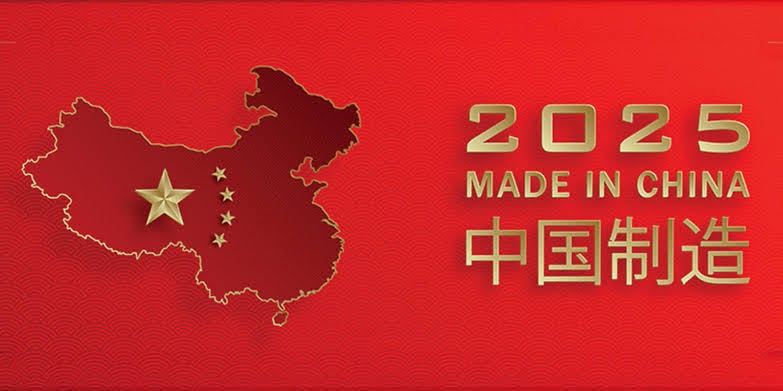
It named 10 strategic priority industries targeted for massive state support, subsidies, and aggressive research and development (R&D) investments - and of course they welcomed foreign investment into these areas also, as long as this development lived in and remained in China.
New advanced information technology
Automated machine tools and robotics
Aerospace and aeronautical equipment
Maritime equipment and high-tech shipping
Modern rail transport equipment
New-energy vehicles (NEVs) and equipment
Power and electrical equipment
Agricultural machinery and equipment
New materials
Biopharma and advanced medical products
This plan didn’t actually end in 2025, but aspirationally the milestones set were:
By 2025: Achieve breakthroughs in core industries and reach a 70% self-sufficiency benchmark across the targeted sectors.
By 2035: Reach parity with or surpass leading global industrial powers in most high-tech areas.
By 2049: Establish undisputed global leadership in manufacturing, innovation, and global tech standards by the centennial of the People’s Republic
Almost immediately, the Chinese government started squeezing all the major multinationals - and the biggest of these was Apple. Apple was surprised, because they were already pouring tons of money into China - but they realized they needed to make more of a public relations blitz out of it; they weren’t “getting credit for it” as it were.
So, in 2016, Apple proposed to invest $275 billion in China over the next 5 years. This was an amazing figure. By comparison, the Marshall Plan to reconstruct Europe after World War 2 was $13.3 billion over four years - and inflation-adjusted to 2016 dollars, it’d be about $131 billion. Apple was going to basically double that, just in the technology sector, and just into China. Or comparably, this was likewise more than all Canadian and American private investment into Mexico from the signing of NAFTA in 1993 through 2020. And this wasn’t just money - this was knowledge transfer about how to build the best phones, the best screens, the best chips, the best tablets, the best laptops, and the supply chains that made them all work efficiently. Notably, this playbook would be replicated by Tesla very shortly thereafter, setting up car manufacture in the Shanghai Gigafactory and making the status symbol car everyone in China wanted (and spurring BYD to build an exceptional set of competitor vehicles as fast followers). China’s success at New-Energy Vehicles, many categories of consumer electronics, and especially the lithium-ion batteries that power both are, to no small extent, learnings from building for Tesla and Apple.
Tim Cook, Apple’s CEO since 2011, is stepping down in September 2026. It’s been an amazing run for him; he’d been outed back in 2014 which might have otherwise caused some difficulties in certain nations (including China) but he seems to have navigated it well enough. Whether his legacy will be the tremendous growth of Apple to a ubiquitous device recognized and owned worldwide - or a more complicated picture of a firm that in many ways may have spent the future to grow today - remains to be seen. But it is, nonetheless, very impressive what Apple has managed over this time frame - and I’m sure Xi Jinping is very appreciative of the work Apple has done to build China’s industry towards his goal of Made In China 2025.
Great information! Its amazing that countries that over civilize start losing traction...
Universe 25 !
Excellent article. How successful do you think the Iphone pivot to India will be, and what is your opinion on Tim Cook's successor, John Ternus?